


If Henry David Thoreau had opened a restaurant, this would be it. According to Bloomberg news, it’s "one of the most exclusive dinner reservations on the planet," and diners from all over the world wait as long as five years for reservations. This bistro is not located in Manhattan, Paris, or Barcelona, but in the finished basement of a man’s modest private home in rural Earlton, New York.
To visit this restaurant online, click here.
To take a virtual video visit,
click the white arrow in the window below
To take a virtual video visit,
click the white arrow in the window below
🍎 🍑 🍒 🍓
If you do not see a window above,
click here to watch the video on YouTube.
-------------------------------
Why did this man's
story inspire me?
story inspire me?
Because he didn’t attend culinary school. He didn’t apprentice at a famous restaurant. Yet diners from over fifty countries have paid upwards of $255 a head for a 20 course meal at his restaurant. This self-taught chef calls his cuisine "Native Harvest" because he farms the food himself on his 12-acre land and then cooks and serves it with his own two hands.
Certainly anyone who embarks on a quest to fulfill a vision will cheer Damon Baehrel's philosophy. (Writers and artists especially.) The film Field of Dreams put it this way: "If you build it, they will come." In Damon’s case, they certainly did.
Certainly anyone who embarks on a quest to fulfill a vision will cheer Damon Baehrel's philosophy. (Writers and artists especially.) The film Field of Dreams put it this way: "If you build it, they will come." In Damon’s case, they certainly did.
Damon wasn’t kidding about preparing everything on his own farm. He makes dozens of varieties of aged cheeses, cured meats, flours, vinegars, pressed oils, butters and breads on premises.
Foodie Magic 8 Ball...
For "New York" in "Late Feb.," the Foodie Magic 8-Ball Chart tells me the following foods are in season: onions, turnips, carrots, apples, and potatoes. Winter squash was harvested and stored for sale now, too.
But first a little...
FOODIE FYI
Damon Baehrel was honored last year by the James Beard Awards with a semifinalist nomination: Best Chef in Northeast Region. As it happens, the JB foundation will be announcing its 2014 award nomination list tomorrow, Feb. 19. Good luck to all the chefs and restaurants!
 |
| Cleo Coyle, who looks forward to pouring a cuppa joe for Daniel Boone (in the afterlife), is author of The Coffeehouse Mysteries |
Maple-Roasted
Acorn Squash
Warm and buttery, dripping with maple syrup, this roasted acorn squash feels almost sinful to eat, yet there’s very little butter and maple syrup involved. Packed with nutrition and dietary fiber, it makes a wonderful "writer’s snack" for me on a fall or winter afternoon.
If you would rather not use butter and/or maple syrup, then lightly coat the squash with a neutral-tasting oil (canola or vegetable oil or even coconut oil if you like coconut flavor). This will protect the flesh against the high heat. You can eat it naked or sprinkle it with your favorite seasonings—be they nutmeg and cinnamon or chili and cayenne pepper. Or try a bit of orange juice, which is also delicious.
May you eat with joy and in good health! ~ Cleo
May you eat with joy and in good health! ~ Cleo
To download this recipe in a
PDF document that you can
print, save, or share, click here.
PDF document that you can
print, save, or share, click here.

HOW TO PICK AN ACORN SQUASH: Your squash should feel heavy in the hand for its size. Green is the most common variety. The skin should be dark green and dull (not shiny)—partial orange on the green skin is fine, but overall it should be more green than orange. It should also be free of moldy spots, and the skin should feel hard and never soft or mushy. An acorn squash does not need to be refrigerated. Stored in cool, dark places, it can keep for a month or more.

NUTRITION: Winter Squash is a good source of Dietary Fiber, Vitamin A, Vitamin B6, Folate and Magnesium, and a very good source of Vitamin C, Thiamin, Potassium and Manganese. Even the starch is healthy. In recent studies, it’s been shown to have antioxidant, anti-inflammatory, as well as anti-diabetic and insulin-regulating properties. Read more here.
Ingredients
1 Acorn Squash
1 Acorn Squash
1 Tablespoon butter or margarine (1/2 T. for each squash half)
1 Tablespoon pure maple syrup (1-1/2 teaspoons for each half)
Pinch of kosher salt or coarse sea salt (optional)
Baking or roasting pan or glass baking dish (the pan should have high edges)
Directions:
Step 1 – Cut and clean squash:
Step 1 – Cut and clean squash:
end of recipe).


Step 2 – Score and smear: Using a small knife, aggressively sore the insides of the squash halves in a checkerboard pattern. This simple step makes a big difference, allowing the butter and syrup to
better penetrate the flesh.
better penetrate the flesh.
 Now gently smear the butter (1/2 T. for each half) over all exposed areas of the acorn flesh to protect it from the high heat. Drop the remaining butter into each cavity. (Optional – lightly sprinkle with coarse salt. For me, this makes a nice foil with the sweetness, but you can omit.) Drizzle 1 tsp. each of maple syrup around each cavity with the butter. Pour ½ teaspoon each into each cavity. Place these halves in a baking pan, as shown with the cut sides up.
Step 3 – Prep a water bath: The water is the magic key to the perfect roasting process with minimal butter and syrup, allowing the flesh to cook and caramelize without drying out or burning in your very hot oven. Add about 1/4 inch (or just a little less) of water to the bottom of your baking pan (which should have high sides) or glass baking dish.

Step 4 - Bake in your well pre-heated 400 degree F. oven for 1 hour. You may need to bake an additional 15 minutes or so, depending on your oven and the size of your squash and how many you cook at a time. Undercooking is the enemy here. You do not want a squash that has not cooked through and caramelized with that butter and maple syrup. So watch for the squash flesh to become very soft and the tops to become lightly browned (see my photos).
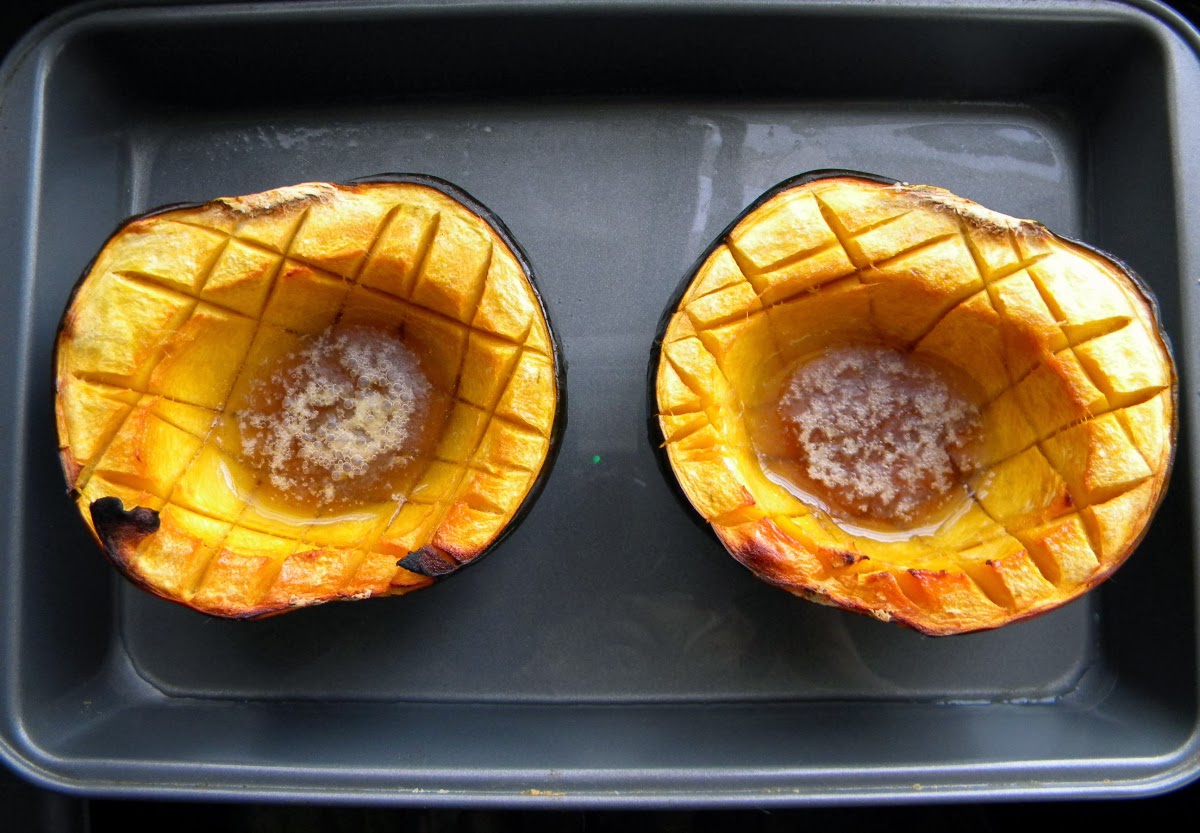
 Step 5 – Spoon and serve: Remove the squash halves from the oven and spoon any visible syrup over the edges before serving.
Roasting Seeds: Just like pumpkin seeds, the seeds from a winter squash are delicious and nutritious. Wash off the stringy goo from the squash innards and dry them well. Line a baking sheet with parchment paper or foil. Spread the seeds in a single layer. Salt them lightly if you like, and roast them right beside the acorn squash (at 400 degrees F.) for about 6 to 8 minutes.

Maple Roasted
Acorn Squash PDF
Acorn Squash PDF
 |
| Click here to download this recipe in a free PDF, and... |
Eat with joy!
~ Cleo Coyle
New York Times bestselling author of
The Coffeehouse Mysteries
 |
Yes, this is me, Cleo (aka Alice).
Friend me on facebook here.
Follow me on twitter here.
Visit my online coffeehouse here.
|
Now a National
Bestseller in Hardcover
Bestseller in Hardcover

A Coffeehouse Mystery
*Starred Review* -Kirkus
"Top Pick" -RT Book Reviews
"...a highly satisfying mystery."
-Publishers Weekly

.jpg)
The Coffeehouse Mysteries are bestselling
works of amateur sleuth fiction set in a landmark
Greenwich Village coffeehouse, and each of the
13 titles includes the added bonus of recipes.
* * *
Haunted Bookshop
Free Title Checklist,
Free Title Checklist,


Great post. I love acorn squash and usually roast it cut side down in a pan. So good. I tried the interactive "in season" chart.....I live in Virginia, it said 'nothing' !!!!! LOL, it did advertise a cookbook though.
ReplyDeleteSharon S - Thanks for the nice word on the post, I appreciate it! On the acorn squash, I loves me the water bath method because I can fill the cavity with all kinds of flavorful things. It's a nice, versatile veg. You can stuff it, steam it, microwave it (as Karen mentions below). But I'm one of those not-so-disciplined dieters who loves to have butter dripping from her chin, and this will do the trick with minimal damage to ye olde diet.
DeleteOn my blog's Magic 8-Ball "In Season" Interactive Chart, there are indeed some states that say "nothing is in season" at this time. :-( -->> BUT...you can still have fun with the chart! I played with some options for you...
According to the chart, you can...
(a) drive down to "North Carolina" for "Apple, Peanuts, and Sweet Potatoes" OR...
(b) Drive up to PA for "celery, lettuce, potatoes, and turnips"
OR...
(c) Wait a few weeks because in “early March” you’ll have “greens and spinach” in season right there in VA.
I'm joking, of course. We truly are spoiled in our modern life with trans-world shipping. We can have produce flown in from Mexico or trucked in from California. (BTW I checked out what's in season in CA on the chart at this time, practically everything!)
On the other than, it’s nice to support local farmers and the chart helps me stay aware of what they might be offering from season to season, even month to month. As we move into the growing season, I hope it helps you and others, too.
Have a great week, Sharon, and
may your Field of Dreams be a tasty one!
~ Cleo Coffeehouse Mystery.com
“Where coffee and crime are always brewing…”
Cleo Coyle on Twitter
www.CleoCoyleRecipes.com
Mmm, one of my favorite winter veggies! They last way more than a month, though, especially if you grow them your own self.
ReplyDeleteYou can microwave squash, too. I use a glass pan with water in the bottom, add butter to the cavity, and then cover it all with plastic wrap. Very fast, although you don't get that yummy caramelization from roasting.
Love the idea of a restaurant that serves only self-grown, self-sourced, and self-cooked fare.
Karen - I'm glad you said that about winter squashes lasting more than a month. From what I've read, they can last up to six months if stored properly. Is that not amazing? (Applause for the winter squashes!)
DeleteYour microwave method is a great one to keep in mind for anyone in a hurry or even for making soup. Just zap it, scrape out the flesh, toss it in a pan with some broth (vegetable or chicken) and a bit of milk or cream. A hand blender makes quick work of smoothing it all out, or you can pop it in a standing blender and…*voila!* hot, hearty soup with great fiber and nutrition. Very filling and very good.
Finally, I'm glad you enjoyed the story of Damon's restaurant. He inspired me on many levels, from making a (seemingly) crazy dream come true on his own terms…to fostering awareness of the sustaining foods that thrive on the land and trees close by us all.
Thanks for dropping by today, Karen,
and may your week be a delicious one!
~ Cleo Coffeehouse Mystery.com
“Where coffee and crime are always brewing…”
Cleo Coyle on Twitter
www.CleoCoyleRecipes.com
That chef wears more hats than you writers! I didn't think that was possible!!!
ReplyDeleteThis looks lovely and must taste delicious. Thanks for another beautifully presented goody.
Libby - It's always a pleasure to see you in our Kitchen. And you're so right about the many hats. Anyone reading this who is writing and publishing today knows exactly what that means! Now that you've brought it up, the metaphor lends some nice insights...
DeleteInstead of complaining, Damon takes pleasure in wearing all those hats. In fact, he insists on it. With each hat, he's able to devote his own creative energy to the task at hand, putting great care into every step (farming, cooking, serving), making sure it's part of his vision. Another facet of inspiration that I hadn't considered until you mentioned it.
Cheers, Libby!
~ Cleo Coffeehouse Mystery.com
“Where coffee and crime are always brewing…”
Cleo Coyle on Twitter
www.CleoCoyleRecipes.com
There used to be a restaurant in Washington that did something similar. Their farm was located in the country, though. I'm so glad that people are waking up about the source of their food.
ReplyDelete~Krista
Krista - You're so right. I remember speaking with a restaurant professional years ago who had a vision for local farm-to-table. That's become very common now! More than ever, chefs are bringing in as much local food as they can. They're even scripting their menus that way, listing particular farms where ingredients came from. It will be interesting to see how this plays out into the future. Every generation, it seems, embraces something new about food--even if it's returning to a process that's essentially very old!
Delete~ Cleo Coffeehouse Mystery.com
“Where coffee and crime are always brewing…”
Cleo Coyle on Twitter
www.CleoCoyleRecipes.com
Cleo, what a fun post about this chef-pioneer. And the recipe is so simple, yet sounds divine. Thanks for sharing!
ReplyDeleteDaryl / Avery
Thanks, D/A, I'm glad you enjoyed it!
ReplyDeleteThis recipe is about the easiest way I know to have maple-syrup infused butter dripping down my chin without one moment of dieter's guilt. I'm also happy you enjoyed the story about Chef Damon, too. He's truly an inspiration.
~ Cleo Coffeehouse Mystery.com
"Where coffee and crime are always brewing…”
Cleo Coyle on Twitter
www.CleoCoyleRecipes.com