Showing posts with label Reading Terminal Market. Show all posts

Friday, June 3, 2016

Cheesecake in a Bowl


In honor of the imminent release of Dead End Street next week, I thought I’d revisit Philadelphia food. I wrote a post about it when the Museum Mystery series debuted, back in 2010. If you take a look at that, I gave a basic primer on the food most often associated with that city. Let me add a few that I missed last time: Philadelphia spawned Cheez Whiz, Good & Plenty, Herr’s (potato chips—my daughter’s suburban school actually took a field trip to their plant), Tastykake, and Fleer Chewing Gum (home of Double Bubble, my childhood favorite--my commuter train used to go by the factory).

But whenever I'm in Philadelphia I keep coming back to the Reading Terminal Market—and I send Nell Pratt there every chance I get. The place has a long history (which I will shorten here for you): it occupies the space under what was once the Reading Railroad Terminal in Center City, close to City Hall. The Terminal opened in 1893, and the market beneath has been there ever since (even though trains no longer run into the terminal: it’s the Pennsylvania Convention Center now, but the market survives, and didn’t even close during the construction of the convention center above it).

The market has just about everything: meat, fish, fruits and vegetables. Ice cream and candy (including some really weird chocolates). Cookware and cookbooks. Great places to grab a lunch, which many nearby workers do. I try to visit every time I’m in Philadelphia, and I come home with whatever I can carry (note: some items do not fare well in a suitcase!). There are Asian and Amish and Italian vendors, and just about anything else. It is one of the great treasures of the city, and it’s always full of people.

Ah, food. What have I bought and enjoyed? Mushrooms (which I’ve also written about for MLK). Meat from the Amish butchers. Chocolate Liberty Bells. Great lunches at the Down Home Diner (yes, I’ve even eaten a cheese steak there). It’s a great space to stroll through, and even if you aren’t hungry when you walk it, you will be after a few minutes.


Recipe? What better than a cheesecake made with the Original Philadelphia brand cream cheese? According to their website, the name "Philadelphia" was adopted in 1880, because the city “was considered at the time to be the home of top quality food.” And it came in foil wrappers even then. (Oddly enough, the parent company resides in the UK.) There have been a few changes in ownership since 1880, not to mention a variety of new! trendier! products, but the Philadelphia name is still on the package. And I firmly believe it is the best cream cheese to use for cheesecakes.

You would not believe how many cheesecake recipes the company offers (twelve pages worth), but I wanted to use something fairly classic, and also take advantage of the ripe strawberries available now. So I tinkered with a few recipes, and here’s the result!


Cheesecake in a Bowl
Ingredients:

1-1/2 cup crumbs (cookie, graham cracker, whatever—I used Sandies)
3/4 stick (3 oz.) butter, melted


1/2 pound block cream cheese, softened
4 oz. white chocolate chips
1 cup heavy cream
1-1/2 Tblsp granulated sugar
1 tsp gelatin, dissolved in 1-1/2 Tblsp boiling water (stir quickly to dissolve!)


2 cups strawberries, pureed (you can put them through a sieve if the seeds annoy you)—or you could just mash them up
2 Tblsp confectioner’s sugar

A few fresh strawberries, sliced or quartered, for garnish


Instructions:

Crumbs and butter, mixed
For the crust layer: combine the crumbs and the butter, then press into the bottom of serving glasses. [A note: you can divide this into as many portions as you like. I happen to have four glass bowls that actually match, so I went with those. Splitting this among six bowls would still be an ample serving size.] Chill.


For the filling: Melt the cream cheese and the white chocolate in a bowl over simmering water, or in a double boiler [you could probably do it in a microwave, but I wasn’t sure of the timing or temperature]. Mix and let it cool for 10 minutes.


Whip together the cream and sugar until stiff. Add the dissolved gelatin to the cream cheese mixture, then fold in the cream.


Taste the pureed strawberries and add confectioner’s sugar if necessary.

First layer
Second layer

Spoon half the cream cheese mixture over the crumb layer in the glasses or bowls, then top with half the strawberry puree. Repeat. Take a knife and gently swirl the layers together just a bit.


Chill for two hours or until set. When you’re ready to serve, garnish with the fresh strawberries.


Dead End Street will be released next Tuesday, June 7th. The cover shows you the part of Philadelphia you don't want to visit. But it's a wonderful city, with great history, amazing museums, and good people working to make it a better place. Definitely worth seeing!

Find it at Amazon and Barnes and Noble.

www.sheilaconnolly.com


Friday, May 27, 2016

Ginger Biscuits

Here at MLK we offer you all kinds of recipes: treasured family favorites, crazy things we’ve stumbled over in our travels, quick and easy ones, innovative ones. Everything you will ever need! Which means we’re always looking for another recipe.

Recently at Malice Domestic I stopped at the vintage-bookseller’s table. They always put it right next to the entrance (how cruel!). I should know by now to shut my eyes and march past, but I don’t.

This year’s prize is The Complete Illustrated Cookery Book, with no apparent author, edited by “CHEF.” It contains “Over two thousand recipes” plus hints on just about everything else related to food and kitchens. There are pictures, some in color (all of which the editor promises were made from recipes included in the book). It was published in England in 1934.


The world has changed a wee bit since then. The thing weighs several pounds and is 2-1/2 inches thick, with small print. I sat myself down with it to skim through it, and ended up laughing hysterically. You’ll see why when I give you only a few examples of suggested recipes:

Baked Eels: to skin an eel, hold it with a cloth. The head should be cut off, the skin turned back at the top all round the neck, then drawn downwards. Draw the head one way and the skin the other. Open the fish and remove the inside. Cut off the back bristles. [Needless to say, I will not be cooking eel any time soon.]

To Dry Haddock at Home [another “I don’t think so” recipe]: Remove the eyes, the gills and the inside, and cleanse the blood from the backbone… Now fill the body and eye sockets with salt.”

Liver Crepinettes: One can buy pig’s caul from the butcher. [Not in this town!] …rinse it well and cut it in pieces with a pair of scissors to any size desired. [How do I know what size pieces of pig’s caul I want?]

But wait! There’s more!

Calves Brains en Matelotte: The brains should be washed in cold water with a little salt. Take away the loose skin and any clots of blood…

Is it just me or is this beginning to sound like a CSI episode?

Here’s a good one: Stewed Tendons of Veal [Yes, you read that right—the tendons, aka the gristles—do something else with those nice tender veal breasts they were attached to.]: Put them [the tendons] in a stewpan…put the pan over the fire, then simmer for 4 hours. [To serve] arrange the tendons in a circle round a dish with a fried crouton between each and fill the centre with a puree of green peas. [Are you hungry yet?]

And it goes on. There is a recipe for Larks a la Bourgeoise (doesn’t say where to get the larks); for a Pupton of Pigeons (which in addition to pigeons includes 1 sweetbread, ½ pound of bacon, and 1 ox palate (???). Later there is a recipe for a Turkey Stuffed with Truffles [really?], and instructions for How to Truss Blackcock [excuse me, I wouldn’t know a blackcock if I met one—apparently it’s a kind of black grouse]. The instructions include “scald the feet, peel off the skin, and cut off the toes.” And if you leave the head on, you must remember to tuck it under one wing. And finally, there’s Rook Pie (you must be sure to remove the backbone, else it will be bitter). [Would a crow do?]

Oddly enough (by MLK standards, at least), there is much more emphasis on meat and poultry than on desserts or sweets. But it may be revealing that a former owner marked very few pages—and the one for Rich Bride Cake was one of them. There is (hard to believe) only one recipe for Cookies in the book, with the notation “(An American Recipe).” It involves boiling them in lard. No thanks.

What? You want a recipe? I will gladly offer you Ginger Biscuits.


Ginger Biscuits

Ingredients:

1/2 lb flour
Pinch of salt
1 tsp ground ginger (you can use more)
4 oz butter
4 oz castor (white) sugar
2 eggs

I don't know what I did before I
had a kitchen scale! (BTW, it also
works for postage.)


Instructions:

Mix together the flour and salt with the ginger in a basin. Beat the butter and sugar to a cream. Add the eggs one by one, beating each in well, then gradually stir in the flour. Should the mixture be too dry, add a very little milk.


About a tablespoon?

Drop spoonfuls of the mixture on greased paper on a greased tin a very short distance apart. Put them into a rather slow oven [I guessed 325 degrees, and I found 20 minutes worked well at that temperature] and bake a pale brown for 15 to 20 minutes. Note, Ginger Biscuits do not become crisp until they are cold.


That’s the recipe as given. I love the way older cookbooks assume you know what you’re doing in the kitchen and can fill in the blanks! You will note a few rather vague points, like the temperature of the oven, and the size of the spoon. I beefed up the ginger and the butter, and everything worked fine. I will say I approve of the greased baking sheet plus the greased parchment paper—the cookies slid right off.


Actually the cookies or biscuits were rather nice—not too sweet, not too spicy, and easy to make. I might just keep this recipe handy.


Hey, less than two weeks before Dead End Street hits bookstore shelves everywhere! 

No recipes, but I did send Nell back to the Reading Terminal Market again in the book. I can't stay out of that place! Maybe next week I'll give you a Philadelphia recipe? (Not scrapple, I promise--the less you know about that, the better.)

Dead End Street is available for pre-order at Amazon and Barnes and Noble.

www.sheilaconnolly.com

Friday, May 6, 2016

Quick Thai Curry

It has to be spring somewhere, doesn’t it? Things were a lot greener in Maryland, where I spent the past weekend with some of my Mystery Lovers’ Kitchen buddies at the mystery conference Malice Domestic. We had a wonderful time, but to be fair, the weather was kind of lousy, with rain and mist and fog. Then I came home—to more rain and mist and fog. (At least all my flights were on time!)

So I wanted something quick and easy and a little spicy, and I decided on Thai curry. I’ll admit I first met this kind of recipe on the back of a curry jar (with a nudge from my daughter, as I recall), although since then I’ve found a couple of great Thai restaurants not far from my home.

This is a very flexible recipe: I’m giving you the basics, but you can add whatever you have on hand or that sounds appealing to you. We’ve learned to keep a lot of the basic ingredients around, which is easy because they’re usually either found in a can or in a form you need to refrigerate.

One note: in a supermarket, you will most likely find two kinds of paste curry: red and green. I’ll confess I don’t know the subtle differences between them, but you can swap between them. I happened to have the red kind, so that’s what I used.

Quick Thai Curry

Ingredients:
Oops--ignore the tomatoes. I was thinking
of an Indian curry recipe, then changed
my mind


1 Tblsp vegetable oil
3/4 cup sliced shallots (you could substitute the same amount of onions, but shallots have a milder flavor)
2 tsp Thai curry paste (or more!)
1 14-oz can of unsweetened coconut milk
2 tsp fish sauce
1 lb skinless, boneless chicken breasts, cut into strips
Optional garnishes: fresh basil, fresh lime juice


Preparation:


Heat the oil in a large saucepan over medium heat. Add the shallots and the curry paste and stir until the shallots soften (about 2 minutes).


Add the coconut milk (note: when you open the can it may look kind of like spackle. Just mix it up to combine the solids and liquids) and the fish sauce. 


Add the chicken and stir the mixture until the chicken is just cooked through. (Another note: I’ve often made this recipe with left-over chicken, which works fine. But the uncooked chicken stayed nice and tender.)


Taste and add salt and pepper as needed, plus any spices that suit your fancy.


You can serve this on its own, or over rice or rice noodles. I felt the need for some green/vegetable addition, and we happened to have some fresh pea shoots on hand, so I sprinkled them over the curry. That worked just fine—they added an earthy note and a hint of crunch.

As I said, feel free to improvise. The result is warm and creamy and as spicy as you want to make it—perfect for a cold damp day!


Coming next month! I can't recall if I ever ate Thai food in Philadelphia, but there are Asian vendors at the Reading Terminal Market in Center City, if you're hunting for ingredients (I send my heroine Nell Pratt there whenever possible, including in this book).  They have everything there, including chocolate noses. Just in case you need a few.

You will find Dead End Street available for pre-order at Amazon and Barnes and Noble.


Friday, May 15, 2015

Scallops with Ginger-Soy Aioli

by Sheila Connolly


You know you’re a foodie when the first thing you do when visiting the country’s great cities is find a market.

I just came back from a conference/research trip (the MWA Edgar Awards, Malice Domestic, and an upper-crust party in Philadelphia) that took twelve days and covered multiple states. I’m not complaining (except for the humongous suitcase that I came to hate and would gladly have tossed under a train), although I think I left my brain somewhere along the way. But worth it!

Grand Central Market


The first stop was New York, where the conference hotel sat literally atop Grand Central Station. While I had taken trains in and out of there in the past, I never realized there were other parts of the station I knew nothing about. Thanks to a friend who dragged me off to lunch, I discovered the Market and the Food Court. Oh joy.

I ended in Philadelphia, where I used to work. The first thing I did (after checking into my hotel and getting rid of that suitcase) was to head straight to the Reading Terminal Market and eat a cheese steak at the Down Home Diner. The market has been around for well over a century and has an amazing array of foods. I try to stop in every time I’m in town to buy mushrooms (did I mention that Pennsylvania is the mushroom capital of the world?) that I can’t get anywhere else. Chanterelles (you don’t want to know how much they cost), hen of the woods, beech mushrooms, oyster mushrooms, trumpet mushrooms—I snagged them all, and this week my husband and I are eating a lot of mushroom recipes (starting with a lovely risotto…).

Philadelphia's Reading Terminal Market
Mushrooms--yes, I bought them all

But the recipe I wanted to share came from my hotel in Philadelphia, Morris House. A colleague alerted me to its existence a few years ago. It’s a tiny place (15 rooms) in an 18th century house in center city, close to all the historic monuments I want to visit. It has been lovingly restored, and each room is different. Where else can you find a real fire burning in the fireplace in the breakfast room?

It also has a restaurant called M. In last year’s book in the Museum Mysteries series, Razing the Dead, I set a romantic scene there, between my protagonist Nell Pratt and her FBI whatever-he-is James Morrison. Nell is sure he’s trying to break off their relationship (she was wrong). For details you’ll have to read Razing the Dead and the forthcoming Privy to the Dead.

I ate at the restaurant in honor of Nell and James. In the kitchen the woman chef called out orders to the kitchen staff, and I was reminded of Gordon Ramsay. I like to know how things work, including kitchens. Gordon came to mind again when I ordered the scallops (if the show Hell’s Kitchen is any indication, Gordon doesn’t think anyone in the world can cook scallops right).

I’m getting to the food, really. After all this, I’m giving you a quick and simple recipe.


Scallops with Ginger-Soy Aioli

I wish I could tell you that I went to the kitchen and demanded this recipe after the first bite, but I managed to restrain myself.

1/2 cup mayonnaise (if you’re a purist you can make your own—I used Hellman’s)
3 Tblsp soy sauce
1 Tblsp coarsely grated fresh ginger
1 Tblsp fresh chives, diced finely
Juice of half a small lemon

Simple, isn’t it? Just mix them together and you’re good to go. One piece of advice: taste as you add the ingredients. The amounts are suggestions, and you can tweak them as you like. You could also add garlic (with restraint!), or cayenne (just a dash) or horseradish (a pinch).

The aioli--looks so innocent, doesn't it?

Sauté your scallops briefly in butter, with the aioli on the side for dunking. Serve immediately with salad greens lightly tossed with vinaigrette. I found that the scallops are the perfect complement to the aioli, because their sweetness cuts the tartness just a bit. But you can use any white fish. Heck, use the stuff as a marinade for chicken—it’s that good.

Look, Gordon--I can cook scallops!

BTW, for a cheese course I ordered unpasteurized sheep cheese (which the menu described as “musty”), which came paired with a dollop of butterscotch sauce. I know, it sounds crazy—but the combination worked. That invisible chef has a wonderful sense for flavors.


Privy to the Dead (Museum Mystery #6), coming June 2nd!

Nell Pratt, president of the Pennsylvania Antiquarian Society, has something to smile about thanks to a generous donation from a major Philadelphia developer who’s willing to help update their museum. But renovations have barely begun when a man is struck by a car in front of the building and killed.

The victim is a construction worker who found a curious metal object while excavating an old privy in the museum’s basement. Nell thinks the death is somehow connected to the Society, and her suspicions are confirmed when an antiques expert reveals a link between the objects from the cellar and a fellow staff member’s family.


Now Nell must unearth a mystery with ties to the past and the present. Because when someone is willing to kill over scrap metal, there’s no telling what they’ll do next…


Available now for pre-order from Amazon and Barnes and Noble.


Friday, July 27, 2012

MORELS

by Sheila Connolly

This past weekend I made a very quick trip to Philadelphia, for an event that was kinda, sorta held in my honor by a person who was the model for one of the main characters in my Philadelphia-based Museum Mystery series.


One of the Reading Terminal Market
vegetable stands

Since the hotel where I was staying was right next door, I had to visit the Reading Terminal Market again.  Twice.  I can't stay away.  Yes, I know I bored you with the fish recently, but this time I was hunting for mushrooms.  (This just might have something to do with the fact that Level Best Books will be publishing a short story of mine in November called "Kept in the Dark," which is about…a Pennsylvania mushroom farmer.)

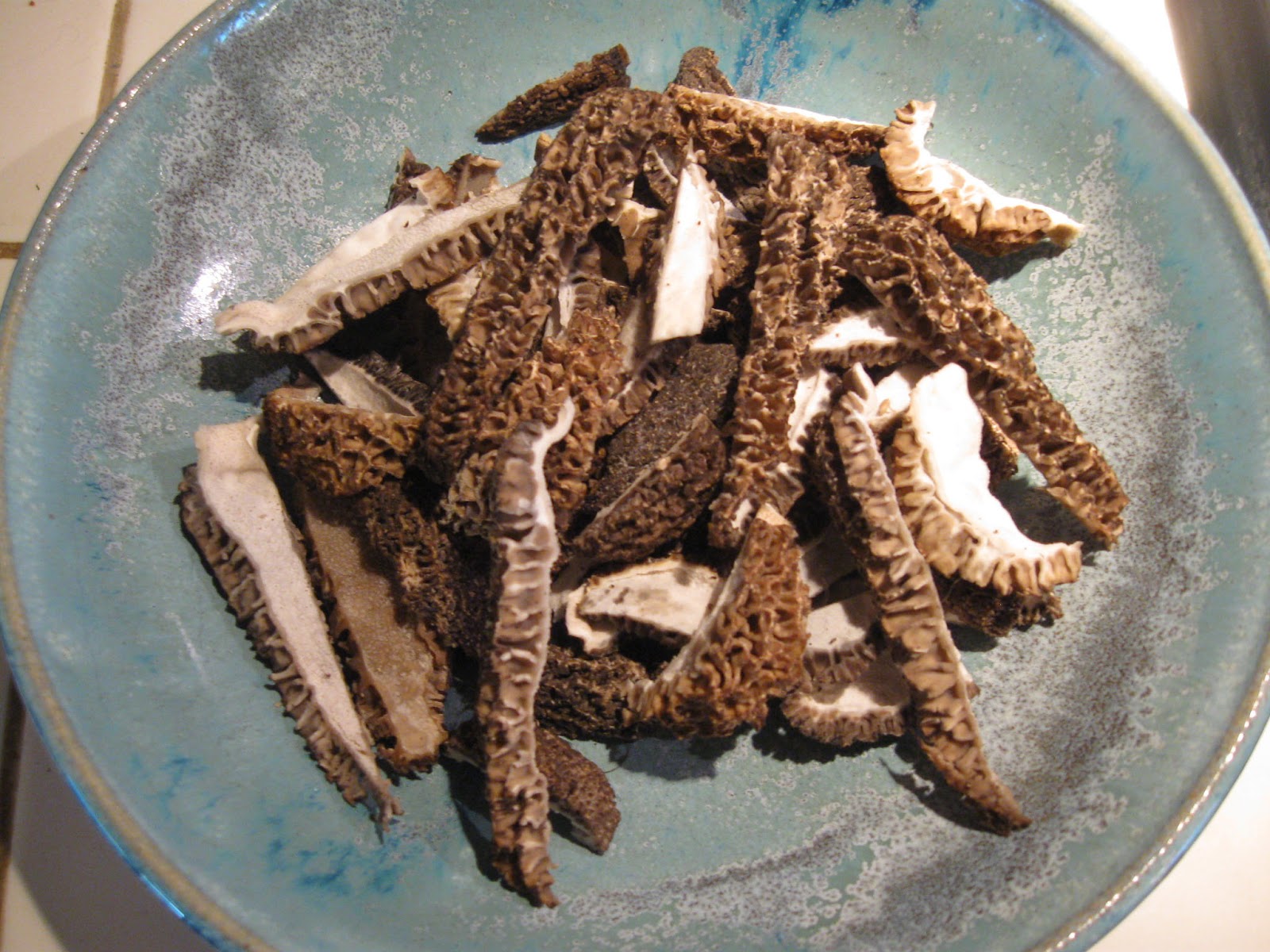
And I found mushrooms, beyond the standard button and shitake and portabello.  I found fresh morels! Jack Czarnecki, the former proprietor of the beloved Joe's Restaurant in Reading, Pennsylvania, where I was privileged to eat many years ago (alas, it moved to the West Coast), called morels "aristocrats of the forest," right up there alongside truffles.  So of course when I see morels, I buy them—and celebrate!

So what to do with a lovely batch of fresh morels?  I turned to Jack Czarnecki's lovely cookbook, A Cook's Book of Mushrooms, for inspiration and found a simple pasta dish that highlights the flavor of the mushrooms (note that this is inspired by the original recipe, not a copy).

Pasta with Morels (or maybe it should be Morels with Pasta)

6 ounces pasta (you may use plain, spinach, or tomato or a mixture).  I had some amusing artisanal pasta that came in a jumble of diverse shapes, so I just picked out about six ounces of the shapes I liked (and I've got lots left), including butterflies

6 ounces fresh morels, cut in pieces more or less the same size as your pasta


2 Tblsp. vegetable oil or melted butter

1 shallot, thinly sliced

1/2 tsp. salt

1 tsp. sugar

1 Tblsp. soy sauce

½ cup beef bouillon

1 Tblsp. arrowroot (if you have it; if not, use cornstarch, but sparingly) mixed with one Tblsp. cold water

Bring about 6 quarts of lightly salted water to a boil and cook the pasta to your taste

While the pasta is cooking, heat the oil or butter in a skillet.  Add the shallot and sauté over medium heat for about a minute, until it softens.  Add the sliced morels and sauté gently until the liquid is drawn from the mushrooms.  Stir in the salt, sugar, soy sauce and stock.  Simmer for another minute, then add the arrowroot mixture and cook gently until the sauce thickens.


Drain the pasta, place in a bowl, and toss with the morel mixture.  Serve immediately. In the amounts given here, it served two.  The available morels were the limiting factor (and they were delicious!).


This is about as simple a dish as you can make with mushrooms.  Of course, you can feel free to experiment by adding any of a number of chopped fresh herbs, or adding heavy cream or crème fraiche. But whatever you do, let the mushrooms shine!


Friday, May 11, 2012

ASIAN MARINATED FISH

by Sheila Connolly

I know, I promised to shut up about fish, but I visited the Reading Terminal Market in Philadelphia earlier this month—one of my all-time favorite food places—and I was reminded again of what I'm missing.  Here's a list of the types of fish that a single vendor had on display:

Squid (whole or cleaned), baby octopus, smelts, spots, croakers, shad, sea trout, mountain trout, silver trout, whiting, porgy, sea bass, mullet, bluefish, perch, red snapper, butterfish, striped bass and bronzino.

To add insult to injury, the most expensive (red snapper and bronzino) were priced at $8.99 per pound, but most were between $2.49 and $4.99 per pound, less than half of what my local market charges for any kind of fish.
Last time I looked, Massachusetts was a lot closer to the ocean than Pennsylvania.  And the Reading Terminal vendors were Amish, which means they come from even further away from the coast.  Why, why must I be so deprived?  I contented myself with taking pictures—it's kind of hard to carry raw fish on a plane. Maybe next time I'll drive—with a very large cooler.

Anyway, here's one more simple and quick fish dish, and then I'll go sulk quietly, at least until I learn to catch my own fish. But then I'd have to learn to filet them.  Oh dear.

ASIAN MARINATED FISH
1½ pounds sturdy white fish (hake, pollock or cod), cut into pieces of roughly the same thickness (so they will cook evenly)

Marinade:

½ cup chopped green onions
3 Tblsp minced or grated peeled fresh ginger
1 Tblsp Chinese rice wine or dry sherry
1 Tblsp peanut oil
1 Tblsp soy sauce

Rinse the pieces of fish and pat dry.  Combine the green onions, ginger, rice wine, oil and soy sauce in a glass baking dish.  Add the fish and turn until the pieces are coated.  Marinate for 1 hour at room temperature.


Sauce:

3 Tblsp sugar
2 Tblsp soy sauce
2 Tblsp Asian sesame oil
2 Tblsp rice wine or dry sherry
1 whole star anise
¼ cup chopped green onions

Bring the first five ingredients to a boil in a heavy small saucepan, stirring to dissolve the sugar (yes, I really do have star anise in my pantry).  Reduce heat to medium and simmer until the sauce is slightly thickened.  Remove the star anise and add the green onions.

Star Anise


Drain the marinade from the fish and pat the pieces dry (save the marinade).  Heat a flat-bottomed pan over high heat.  Add 1 Tblsp of oil and let heat (note:  peanut oil will withstand heat better than most vegetable oils), then add the fish pieces (in one layer) and cover for 30 seconds.  Loosen the pieces from the pan with a spatula, reduce the heat to medium and cook for one minute.  Turn the pieces and cook for one additional minute.


Add the reserved marinade to the pan and cook for one more minute.

Serve with rice, and drizzle the sauce over both the fish and the rice.