Showing posts with label Potluck Monday. Show all posts

Monday, December 5, 2022

Mysteries with Recipes Origin Story by Maya Corrigan #Giveaway Pot Luck Monday

Recipe Cards from Mystery Lovers Kitchen Authors
In my latest book, Bake Offed, which takes place at a mystery fan fest, a book vendor explains the popularity of culinary cozy mysteries: “Today’s readers want to know, not just whodunit, but what to eat for dinner.” The recipes appended to cozy mysteries serve that purpose. Most of the Mystery Lovers' Kitchen writers include recipes in their books. I've read mysteries since my mother brought home an armful of them every week from the library, but I don’t remember any crime novels with recipes in them until the last two decades. I did some research to find out which mystery writer was the first to include recipes in a book. 

The first detective novel with recipes that I’ve been able to find was Too Many Cooks by Rex Stout, which came out in 1938. Stout’s detective, Nero Wolfe, is a gourmand who rarely leaves his home. While solving crimes from his armchair, he obsesses about food, often discussing ingredients and cooking methods with his personal gourmet chef, Fritz. Wolfe appears in Stout’s novels and shorter works from 1934 to 1975, but Too Many Cooks is the one book that included recipes, and only in its first edition. However, those recipes had a life of their own outside of the book.

Rex Stout went on what must be the most expensive book tour ever. The Saturday Evening Post, which serialized Too Many Cooks, held a lavish luncheon in a dozen cities. The guests, influencers like book reviewers and sellers, not only enjoyed a multi-course feast, but also received a keepsake, a book-shaped box containing Nero Wolfe’s recipes. The promotional recipe box, only a thousand of which were produced, is prized by collectors and now worth more than a first edition of the book. The current price for the box in good condition with all recipes is close to $4,000.


Recipe box photos: WFinch, CC BY-SA 3.0, via Wikimedia Commons


The recipe box plays a role in my 8th Five-Ingredient Mystery, Bake Offed. My sleuths, café manager Val and her grandfather, the Codger Cook, are helping a friend who’s running the fest. Besides the usual panels and book signings, my fest also includes a murder and a Deadly Desserts bakeoff, in which Granddad competes. Each contestant must assume the persona of a fictional detective’s cook and bake a sweet the detective would like. Granddad, who promotes five-ingredient dishes in his recipe column, is assigned the daunting role of Nero Wolfe’s gourmet chef, who cooks with “scads of ingredients.” The Too Many Cooks recipe box Granddad finds in the attic has a dessert recipe he can handle. He’s now sure he can win the bake-off against his rival recipe columnist, who plays Mrs. Hudson, Sherlock Holmes’s landlady. On the first night of the fest, Granddad’s prized recipe box disappears and Mrs. Hudson is found dead in her hotel room next to a whistling teakettle. So how do mystery fans who love murder on the page react to a murder in their midst? You’ll have to read the book to find out. 


Readers: Do you look at the recipes included in mysteries? Do you ever try any of the recipes?


I’ll give away a set of recipe cards (shown in the first photo of this post) to one person who comments. DON'T FORGET TO INCLUDE YOUR E-MAIL ADDRESS if you'd like to win the recipe cards.


Monday, October 3, 2022

Quick Breads History by Maya Corrigan Potluck Monday

Photo by Craig David via Pixabay
Bread was leavened with yeast for most of human history, but alternatives to yeast became popular in the last few centuries. Native Americans introduced settlers to pearl ash, a yeast alternative. The first American cookbook writer, Amelia Simmons, included bread recipes made with pearl ash (potash) in her American Cookery. Published in 1796 and reprinted multiple times in the following decades, American Cookery isn't just the first cookbook published in the U.S., but probably the one with the longest title.

Library of Congress 


Pearl ash, which didn’t dissolve easily and or work well for batters with a lot of fat, was largely replaced in the mid-19th century by baking soda and baking powder. These products gave rise to quick breads (pun intended).

Unlike yeast, baking powder and baking soda react immediately when exposed to a liquid, so you don’t have to wait for the dough to rise. In fact, you’re supposed to bake quick breads as soon as you combine all the ingredients. Irish soda bread is one of the original quick breads, dating back to the 1840s, when baking soda was introduced into Ireland.

Here's a selection of quick bread recipes from the Mystery Lovers' Kitchen archives. Several of them are perfect for the Halloween, Thanksgiving, and Christmas holidays.

What is your favorite quick bread? Mine is banana nut.


📚

Maya Corrigan writes the Five-Ingredient Mysteries featuring café manger Val and her live-wire grandfather solving murders in a Chesapeake Bay town. Maya lives in a Virginia suburb of Washington, D.C. Before writing crime fiction, she taught American literature, writing, and detective fiction at Northern Virginia Community College and Georgetown University. When not reading and writing, she enjoys theater, travel, trivia, cooking, and crosswords.


Halloween is on the horizon . . .


CRYPT SUZETTE: ​​When a murder masquerades as an accident, Granddad's ghost-busting and Val's foray into a haunted house turn up clues to the killer. 

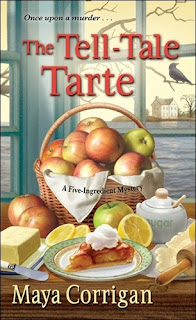
THE TELL-TALE TARTE: When Val serves a dessert at a book club dinner, she uncovers a fraud that embroils her and Granddad in a murder among deadly serious Edgar Allan Poe fans. 

Visit my website for easy recipes, mystery history and trivia, and a free culinary mystery story.

Follow me on Facebook.

📚

Monday, July 4, 2022

Food for the 4th by Maya Corrigan Potluck Monday

Image by Miesha Moriniere from Pixabay 

Happy Independence Day! Food cooked over a fire is as much a hallmark of 4th of July celebrations as fireworks. An estimated quarter of the U.S. population will celebrate with a barbecue today, weather permitting. The practice of grilling meat over a fire originated in the Caribbean, where the indigenous Taino people called this type of cooking “barbacoa.” Hot dogs, burgers, and chicken are the most common meats that are grilled on the 4th of the July. Red, white, and blue desserts are popular, with the color often coming from berries that are ripe in July.

If you’re looking for delicious ideas for your 4th of July celebration, check out these recipes from our archives:


For Caribbean Flavor

My Caribbean Jerk Chicken

Lucy Burdette’s Caribbean Salad

Peg Cochran’s Caribbean Grilled Chicken Breasts


For Dessert

Krista Davis's Berry Trifle 


Daryl Wood Gerber's Red White and Blue Tart 


Cleo Coyle’s Blue Velvet Cupcakes


🎆 🎆 🎆 🎆


If you're in the mood for Christmas in July, check out my latest Five-Ingredient Mystery, Gingerdead Man.

"A wonderfully seasonal cozy mystery"

--Criminal Element

The 7th and latest book in Maya's series is Gingerdead Man.

During Bayport's Dickens of a Holiday festival, Val is hosting a private tea party for the volunteers dressed as Dickens characters including Scrooge and the Ghost of Christmas Past. A Santa who's more naughty than nice also comes to tea. An unexpected guest arrives, "shrouded in a deep black garment" like the eeriest Dickens ghost, and hands out gingerbread men with white icing skeleton bones. Though the creepy treat called a gingerdead man looks like a Halloween leftover, cookie addict Santa can't resist it. When the man in red turns blue, Val and Granddad have a cookie-cutter killer to catch.

"Plenty of red herrings, mixed motives, and recipes for foodies make for a spirited holiday cozy." -- Kirkus Review of Gingerdead Man


Maya Corrigan writes the Five-Ingredient Mysteries featuring café manger Val and her live-wire grandfather solving murders in a Chesapeake Bay town. Maya lives in a Virginia suburb of Washington, D.C. Before writing crime fiction, she taught American literature, writing, and detective fiction at Northern Virginia Community College and Georgetown University. When not reading and writing, she enjoys theater, travel, trivia, cooking, and crosswords. Visit her website for book news, easy recipes, mystery trivia, and a free culinary mystery story.

🎆 🎆 🎆 🎆


What's on the menu for your 4th of July celebration?


Monday, February 7, 2022

S.C.O.N.E.S. and Scones – A Potluck, Spotlight Special by @MysteryMacRae


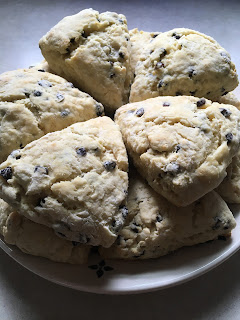
Current scones

Maya Corrigan, our usual Potluck Monday host, kindly shared today with me. Thank you, Maya! And just like a community potluck, today’s post is some of this and some of that—half Spotlight Sunday, where I’ll introduce you to myself and to the S.C.O.N.E.S., and half Potluck Monday where I’ll ask whether you eat scones or scones.


I grew up in a family with six kids, a variety of pets, magazines, newspapers, shelves and shelves of books, and a mom and dad who read to us at bedtime long past the point we could read to ourselves. As a crew, we were quite spread out. Mom and Dad had someone in high school every year for twenty years. Wow. We ate supper together every night. I loved the reading and the family meals. I love my family.

All the wild MacRaes c. 1960
Mom took the picture, Dad is in the back of the boat, I'm in a life jacket on the right.

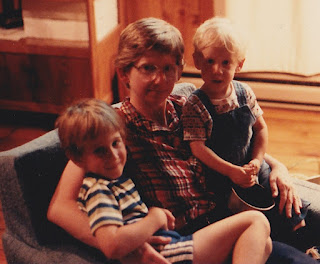
My sweet boys in 1986.
Ross, with the pot, does most of our cooking these days.
Gordon has two boys of his own who like to cook with him.

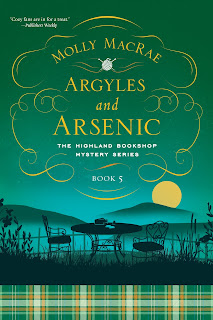
From pesky sister to wife and mom, and through jobs as a museum curator and director, independent bookstore manager, and connecting children with books at the public library, stories and books have been a common thread in my life. My first short story came out in Alfred Hitchcock Mystery Magazine in January 1990. My fifteenth book, Argyles and Arsenic, comes out March 1st. You can find a list of my stories and books here.


Argyles and Arsenic is the fifth book in my Highland Bookshop Mysteries. Writing these books has been my way of returning to Scotland where I spent a year studying British prehistory at Edinburgh University. I love Scotland and don’t get back often enough. The series’ ensemble cast—four women who buy Yon Bonny Books in Inversgail on the west coast of the Highlands—are natural amateur sleuths. Of course, right? They’re so good that they’ve been dubbed the Shadow Constabulary of Nosy Eavesdropping Sleuths (S.C.O.N.E.S.)


As you’ll guess from the title, the latest adventure for the S.C.O.N.E.S. involves arsenic. Also argyle socks, a knitting competition, an evening of decanting and decluttering, a food truck, baked potatoes, murder, and scones—not necessarily in that order.

Words fascinate me as much as stories and books. I like knowing where words come from, how old they are, how they’re used, and how people pronounce them. For instance, if I offer you one of those slightly sweet baked goods that resemble biscuits but aren’t biscuits at all, will I offer you a scone, which rhymes with cone? Not if we’re in Inversgail with the S.C.O.N.E.S. Scone, in Scotland, is almost universally pronounced so that it rhymes with gone and Sean (Sean also rhyming with gone and not bean). In Ireland you’re likely to get a scone (cone). In England and Wales you can’t quite be sure which one you’ll get.


In a massive effort, Cambridge University mapped the variation in scone pronunciation throughout the UK and Ireland. You can see the map here. And you can read a short history of scones at Food Reference.com.
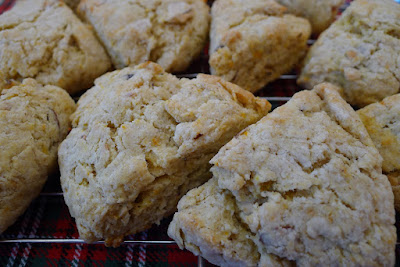
Orange almond scones with cardamom

So do you eat scone-gones or scone-cones? When I lived in Scotland, I was a goner. These days I’m more of a scone-coner. Whichever way you say it, do you have any idea how much we love scones at Mystery Lovers’ Kitchen? As of July 30, 2021, we’ve featured 55 recipes for them on the blog (thank you, Vicki Delany, for counting). Here are links to four of the recipes.


Apple-Cheddar Scones from Leslie Budewitz

Traditional Afternoon Tea Scones from Vicki Delany

Savory Herb Scones from Daryl Wood Gerber

Orange Almond Scones with Cardamom from Molly MacRae


If you’d like even more scone recipes from the blog—or if you’re interested in other recipes we’ve featured, particular ingredients, earlier editions of Potluck Mondays, specific authors, etc.—scroll down the right side of the blog until you get below the line of our latest book covers. When you see the search box for our “Blog Archive,” scroll just a little farther and you’ll see “Search This Blog.” Type your search term in the box, hit enter, and you can search for recipes galore (galore is from the Scottish Gaelic gu leóir meaning sufficiently enough).


Thanks for spending time with me today. For anyone who’d like to, you can connect with me on Facebook, Twitter, Instagram, and Pinterest.


Did you know that pre-orders make the publishing world go round? Part of a publisher’s decision for continuing a series depends on how many books are pre-ordered before the publication date. Writing and publishing are an interesting business. That said, Argyles and Arsenic is available for pre-order in e-book and hardback at Independent booksellers, Barnes & Noble, and Amazon, or ask for it at your public library.


The Boston Globe says Molly MacRae writes “murder with a dose of drollery.” She’s the author of the award-winning, national bestselling Haunted Yarn Shop Mysteries and the Highland Bookshop Mysteries. As Margaret Welch, she writes books for Annie’s Fiction. Her short stories have appeared in Alfred Hitchcock Mystery Magazine since 1990 and she’s a winner of the Sherwood Anderson Award for Short Fiction. 
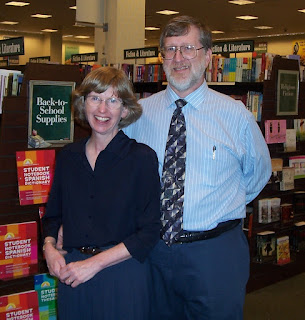
 

My husband Mike and me at a signing for my first book, Wilder Rumors, in 2007. 
We've lived in Texas, Tennessee, and Illinois.
Mike makes the best grilled cheese sandwiches in the world and he paints.


Monday, November 1, 2021

Pie History by Maya Corrigan - Potluck Monday

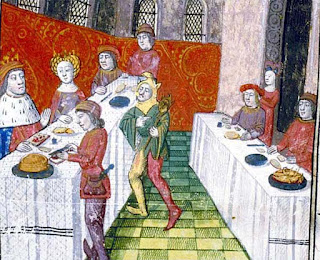
A 15th century feast with a large pie
15th century feasts featured savory pies 
Lifting the lid off a coffin was a pleasant experience in England during the Middle Ages. A coffin or coffyn referred to a container made of pastry, a precursor of the modern pie crust, and food was served in the coffin it had been cooked in. The first printed use of the word coffin as a box for a corpse appeared later, in the 16th century.

Historians trace pies back to ancient times. The Greeks wrapped dough made of flour and water around meat to seal in the juices. The Romans continued that tradition and spread it across Europe. The word pie or pye supposedly comes from magpie, the bird that collects odds and ends of its nest, just as cooks put everything they had into a pie. A recipe from 1450 mentions beef, hens, rabbits, suet, egg yolks, dates, and prunes as some of the ingredients in a single high and hearty “pye.”

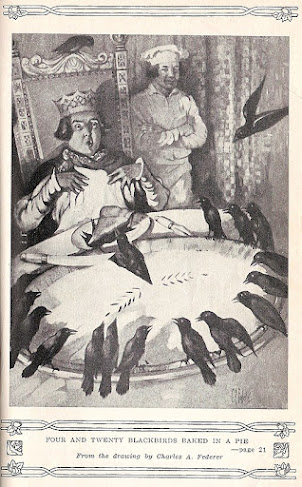
Public Domain Nursery Rhyme Illustration  
The Italian Banquet, a book from the late 16th century, refers to a pie filled with live birds. To make this showy treat, the baker put a fist-sized hole in the bottom of the pastry coffin and sealed up the opening. After cooking and cooling the pie, the baker stuffed live birds in the hole, so that when it was cut for serving, the birds would fly out.

The crust of these savory pies had to be dense enough to withstand hours of heat. The coffin served as a casserole dish, making meat more tender and delicious than hunks of dry roasted meat. But the pastry itself was tasteless and too hard and thick to chew.

As sugar and fat became more available and affordable, the dough containers morphed into the edible pie crusts we know today. By the time the English established colonies across the Atlantic, less heavy dough, a short crust, was common with sweet as well as savory fillings. According to Matt Siegel in The Secret History of Food, the scarcity of wheat in the New England colonies meant that cooks had to stretch the pastry for pies so it became thin and flaky. It's still true that British pie crusts tend to be thicker and denser than American crusts.
 
Mark Twain offers a snarky “Recipe for an English Pie” in his 1880 book, A Tramp Abroad: “Take a sufficiency of water and a sufficiency of flour, and construct a bullet-proof dough. ...Toughen and kiln-dry in a couple days ... Fill with stewed dried apples; aggravate with cloves, lemon-peel, and slabs of citron; add two portions of New Orleans sugars, then solder on the lid and set in a safe place till it petrifies. Serve cold at breakfast and invite your enemy.”

Hard as he is to please, Twain would approve of the pie recipes on Mystery Lovers' Kitchen. Here are a few for you to savor:

Cleo Coyle’s perfect sweet pie crust 

Lucy Burdette's classic apple pie

Chicken Pot Pie by Mary Jane Maffini

Maya Corrigan’s Mango Key Lime Pie


Note that you can still sign up for a free book by leaving a comment on yesterday's post.

Pie is my favorite dessert, but I've never made a savory pie. Are you a pie-lover?


🍁🍂🍁


The title of the fourth book in my Five-Ingredient Mystery series derives from Edgar Allan Poe's story about a murder, “The Tell-Tale Heart.” The victim and suspects in The Tell-Tale Tarte are all inspired by Poe: an actor famed for his one-man Poe show, an author who riffs on Poe stories, a professor who specializes in Poe, and an aspiring writer and Poe lookalike.

When café manager Val Deniston serves a French apple pie, a tarte Tatin, at a book club dinner, the dessert reveals a fraud, embroiling her and her grandfather in the investigation of a murder. The search for the killer takes Val and Granddad to the home of a bestselling author, Rick Usher. Stranded there by an ice storm, they spend a harrowing night in the “House of Usher.” Then, in the shadow of Poe’s tomb, they try to prevent another murder and mete out some POE-etic justice.

🍎🍎🍎


Maya Corrigan writes the Five-Ingredient Mysteries featuring café manger Val and her live-wire grandfather solving murders in a Chesapeake Bay town. Maya lives in a Virginia suburb of Washington, D.C. Before writing crime fiction, she taught American literature, writing, and detective fiction at Northern Virginia Community College and Georgetown University. When not reading and writing, she enjoys theater, travel, trivia, cooking, and crosswords.

Visit her website to sign up for her newsletter. One subscriber wins a book each time a newsletter goes out. Check out the easy recipes, mystery history and trivia, and a free culinary mystery story on the website.


Book covers of the 7 Five-Ingredient Mysteries by Maya Corrigan


Happy Fall! 🍁🍂🍁