Showing posts with label Razing the Dead. Show all posts

Friday, May 15, 2015

Scallops with Ginger-Soy Aioli

by Sheila Connolly


You know you’re a foodie when the first thing you do when visiting the country’s great cities is find a market.

I just came back from a conference/research trip (the MWA Edgar Awards, Malice Domestic, and an upper-crust party in Philadelphia) that took twelve days and covered multiple states. I’m not complaining (except for the humongous suitcase that I came to hate and would gladly have tossed under a train), although I think I left my brain somewhere along the way. But worth it!

Grand Central Market


The first stop was New York, where the conference hotel sat literally atop Grand Central Station. While I had taken trains in and out of there in the past, I never realized there were other parts of the station I knew nothing about. Thanks to a friend who dragged me off to lunch, I discovered the Market and the Food Court. Oh joy.

I ended in Philadelphia, where I used to work. The first thing I did (after checking into my hotel and getting rid of that suitcase) was to head straight to the Reading Terminal Market and eat a cheese steak at the Down Home Diner. The market has been around for well over a century and has an amazing array of foods. I try to stop in every time I’m in town to buy mushrooms (did I mention that Pennsylvania is the mushroom capital of the world?) that I can’t get anywhere else. Chanterelles (you don’t want to know how much they cost), hen of the woods, beech mushrooms, oyster mushrooms, trumpet mushrooms—I snagged them all, and this week my husband and I are eating a lot of mushroom recipes (starting with a lovely risotto…).

Philadelphia's Reading Terminal Market
Mushrooms--yes, I bought them all

But the recipe I wanted to share came from my hotel in Philadelphia, Morris House. A colleague alerted me to its existence a few years ago. It’s a tiny place (15 rooms) in an 18th century house in center city, close to all the historic monuments I want to visit. It has been lovingly restored, and each room is different. Where else can you find a real fire burning in the fireplace in the breakfast room?

It also has a restaurant called M. In last year’s book in the Museum Mysteries series, Razing the Dead, I set a romantic scene there, between my protagonist Nell Pratt and her FBI whatever-he-is James Morrison. Nell is sure he’s trying to break off their relationship (she was wrong). For details you’ll have to read Razing the Dead and the forthcoming Privy to the Dead.

I ate at the restaurant in honor of Nell and James. In the kitchen the woman chef called out orders to the kitchen staff, and I was reminded of Gordon Ramsay. I like to know how things work, including kitchens. Gordon came to mind again when I ordered the scallops (if the show Hell’s Kitchen is any indication, Gordon doesn’t think anyone in the world can cook scallops right).

I’m getting to the food, really. After all this, I’m giving you a quick and simple recipe.


Scallops with Ginger-Soy Aioli

I wish I could tell you that I went to the kitchen and demanded this recipe after the first bite, but I managed to restrain myself.

1/2 cup mayonnaise (if you’re a purist you can make your own—I used Hellman’s)
3 Tblsp soy sauce
1 Tblsp coarsely grated fresh ginger
1 Tblsp fresh chives, diced finely
Juice of half a small lemon

Simple, isn’t it? Just mix them together and you’re good to go. One piece of advice: taste as you add the ingredients. The amounts are suggestions, and you can tweak them as you like. You could also add garlic (with restraint!), or cayenne (just a dash) or horseradish (a pinch).

The aioli--looks so innocent, doesn't it?

Sauté your scallops briefly in butter, with the aioli on the side for dunking. Serve immediately with salad greens lightly tossed with vinaigrette. I found that the scallops are the perfect complement to the aioli, because their sweetness cuts the tartness just a bit. But you can use any white fish. Heck, use the stuff as a marinade for chicken—it’s that good.

Look, Gordon--I can cook scallops!

BTW, for a cheese course I ordered unpasteurized sheep cheese (which the menu described as “musty”), which came paired with a dollop of butterscotch sauce. I know, it sounds crazy—but the combination worked. That invisible chef has a wonderful sense for flavors.


Privy to the Dead (Museum Mystery #6), coming June 2nd!

Nell Pratt, president of the Pennsylvania Antiquarian Society, has something to smile about thanks to a generous donation from a major Philadelphia developer who’s willing to help update their museum. But renovations have barely begun when a man is struck by a car in front of the building and killed.

The victim is a construction worker who found a curious metal object while excavating an old privy in the museum’s basement. Nell thinks the death is somehow connected to the Society, and her suspicions are confirmed when an antiques expert reveals a link between the objects from the cellar and a fellow staff member’s family.


Now Nell must unearth a mystery with ties to the past and the present. Because when someone is willing to kill over scrap metal, there’s no telling what they’ll do next…


Available now for pre-order from Amazon and Barnes and Noble.


Friday, July 11, 2014

Cherry Betty

by Sheila Connolly

We’ve discussed the wonderful world of bettys, slumps, grunts, buckles and the like before, right? (Good thing the results are better than the names!) Some cookbooks have suggested that a "betty" involves using bread crumbs, so that makes this a betty.

There are many fresh fruits available now, and more coming. I found a large bag of sweet ripe cherries and had to have it, but you can use almost any summer fruit for this recipe, although the softer ones like strawberries and raspberries might turn to mush too fast. You can also vary the nuts you use, to match your fruit. This is a flexible recipe that takes advantage of the best your market has to offer this summer.


Cherry Betty

Butter for dish


Crumbs:

5 oz. firm white bread, made into crumbs 
     (about 2-1/2 cups)
1/3 cup chopped nuts
1/3 cup sweetened flaked coconut
1/3 cup unsalted butter, melted

Fruit:

2 pints cherries (you can use berries as well)
1/4 cup granulated sugar
1/4 cup (packed) light brown sugar

1/4 cup cherry preserves

Preheat the oven to 375 degrees. Butter a 1-1/2 quart casserole dish.

(Note: I toasted the crumbs for ten minutes in a slow oven to make them a little crisper, but it’s not essential.) In a bowl, combine the breadcrumbs, nuts and coconut. Add the melted butter and toss with a fork.

Halve and pit the cherries. In a bowl, combine the berries, sugars, and preserves. If your fruit is not very juicy, you can add a small amount of water or juice.

Sprinkle one-half cup of the crumb mixture onto the bottom of the dish. Spoon half of the fruit mixture on top. Sprinkle with another half-cup of crumbs. Add the remaining fruit mixture. Top with the remaining crumbs.

Ready for the oven


Press the mixture down lightly with the back of a spoon.

Baked


Cover the dish loosely with foil. Bake for 35 minutes, then uncover and continue baking for another ten minutes or until the crumbs on top are golden brown. Serve warm with ice cream or whipped cream.

And ready to eat, with or without ice cream!


One last pitch for Razing the Dead (besides, the cover looks nice and summery). If all goes as planned, I've got another (unexpected) book coming in September, and the next Orchard Mystery, Picked to Die, in October, so things are moving fast!

Friday, July 4, 2014

PEA SHOOT AND HAZELNUT SALAD WITH MUSTARD-HONEY VINAIGRETTE

by Sheila Connolly

I was going to give you a recipe for how to cook a weed, but that didn’t sound quite right for the Fourth of July (even though it is a native species of weed!), so you may see that one in coming weeks.

Happy Independence Day! 


Between Massachusetts and Pennsylvania, I’ve been spending a lot of time (in my head, at least) with the Revolutionary War recently. Maybe it was the early influence of Johnny Tremain (written by Esther Forbes and published in 1943; Walt Disney made a movie of it in 1957), which was required reading for my sixth grade English class, but I’ve always found the whole thing romantic—those ill-equipped farmers without uniforms or decent weapons standing up to the might of the well-trained, well-supplied British Empire in defense of their homes and livelihoods and maybe even some ideals. It’s a great story with a happy ending, isn’t it?

Back to the food. Summer has finally arrived around here, and there are parties and fireworks to watch this week (plus that annoying Hurricane Arthur), and mosquitoes to swat, so I’m going to keep it simple. Here’s a nice recipe for a salad with a few little twists.


Pea Shoot and Hazelnut Salad with Mustard-Honey Vinaigrette


Vinaigrette:


1-1/2 Tblsp balsamic vinegar (flavored if you like)
1/2 tsp Dijon mustard
1/2 tsp honey
1 small shallot, minced
1/4 cup extra-virgin olive oil
salt
freshly ground black pepper


Salad:

1/2 cup hazelnuts, chopped
5 oz. baby arugula (or any other small greens you prefer)
3-4 oz. pea shoots (available in packages at your market!)
4 large radishes, trimmed and thinly sliced
1 fennel bulb, trimmed and thinly sliced (the white part only)


Right up front, I’ll give you a choice: you can prepare your own hazelnuts:

Preheat the oven to 375 degrees. Spread the hazelnuts on a cookie sheet and toast until they are fragrant and the skins blister (12-15 minutes).   Transfer them to a kitchen towel and let cool slightly, then rub the nuts together vigorously to remove the skins. Chop the nuts coarsely.

Or you can just buy a package at your market--much simpler! Although the toasting is a good idea because it brings out the nuts’ flavor.

In a large bowl, whisk together the balsamic vinegar, mustard, honey and shallot. Add the olive oil and whisk until blended. Season with salt and pepper.

Arugula--looks like oak leaves, doesn't it?
I
Pea greens
n another bowl, toss the arugula, pea shoots, sliced radishes, sliced fennel, and chopped hazelnuts. Add the vinaigrette and toss again to cover. Serve.


As with any salad, you can add whatever greens are fresh and available. Can’t find pea shoots? Try thin slices of sugar snap peas.


Razing the Dead involves a body (or two or three) found near the site of the Paoli Massacre, a notorious battle from the Revolutionary War, fought outside of Philadelphia. The monument shown on the cover is based on the real one, in Paoli, and is the second-oldest military monument in the country (after the one at Concord, MA, naturally).

Friday, June 27, 2014

Grilled Fish with Caper Vinaigrette

by Sheila Connolly

For some mysterious reason, lately I’ve been possessed by a need to sort and toss stuff. Kind of like the reverse of nesting. Unnesting? My daughter moved out over two years ago, so it’s not that. Maybe I’ve finally reached a breaking point because I’m surrounded by a WHOLE LOT OF STUFF (yes, I’m shouting).

As a small part of this I’ve been going through my recipe collection, both the inherited ones and the ones I started collecting as soon as I had my first kitchen (which was about ten feet square with two cupboards). The oldest recipes come on stained file cards and yellowed newspaper clippings, then progress through Xerox copies of others, and finally neatly typed and formatted copies (such as those from the last five years of Mystery Lovers Kitchen!).

I’ve been sorting them, thinking tabs might be nice if I ever want to find anything (I confess that the Sweet recipes acquired their very own binder years ago--and they do have tabs!). I made a number of happy discoveries: “Oh, look! I saved that!” Having completely forgotten about the recipe, of course. But it’s nice to find recipes that are both tasty and quick, especially for summer, that I tucked away years ago.  Here is one of my finds (or refinds?), an easy grilled fish recipe.


GRILLED FISH WITH VINAIGRETTE

1/4 cup unsalted butter

1 Tblsp olive oil
1/4 cup minced shallots
2 Tblsp balsamic vinegar
1 Tblsp capers, drained
1 tsp fresh herbs, chopped (use whatever you like or have fresh)
1 15-oz can white beans (garbanzo, Northern, etc.), rinsed and drained
1 tsp lemon peel, finely grated
1 1/2 lbs firm-fleshed white fish filets (cod, haddock)

Heat the butter in a small skillet over medium heat until brown, stirring often–about 4 minutes. Remove from heat. (If you want, you can strain off the milk solids, which look kind of like brown sand, but they won’t affect the flavor.)

The browned butter (sounds better in French:
beurre noir)

Mix in the oil, then the shallots, vinegar, capers and herbs (I used fresh thyme).  Season to taste with salt and pepper.

Vinaigrette


Brush both sides of the fish filets with the warm vinaigrette, then season with salt and pepper. I used cod filets because (a) they were fresh and locally caught, and (b) they are sturdy enough to stand up to grilling.


Mix the beans, lemon peel and the rest of the vinaigrette in a bowl and keep warm. (You can add other vegetables of your choice.)

When your coals are ready, grill the fish quickly (cover the grill briefly to make sure the fish is cooked through, but it shouldn't take long).  Place the fish on plates and spoon the warm bean mixture alongside.


I confess that over the years I’ve had little luck with grilling fish directly on my (yes, vintage) Weber grill. However, several years ago I purchased a perforated tray with handles, that fits very neatly on the grill. I don’t get the nice grill marks on the fish, but the smoky flavor comes through and the poor fish pieces don’t self-destruct when you try to scrape them off the grill.

I served the fish with a salad of fresh New Jersey romaine and sliced locally-grown French radishes.


Razing the Dead, Museum Mystery #5, released June 3rd. 

Zac Bissonnette of Writer's Digest had this to say:  "... best book in the series. Really vivid/amazing pacing/and great incorporation of historical stuff/a view into that world ... it's so rare that series get better, but this one most definitely has."

Friday, June 20, 2014

Chilled Pea Soup

by Sheila Connolly


I just returned from a whirlwind week-long trip that included two book signings and visits with various friends and relatives along the way.  It was both exhausting and energizing: I drove over a thousand miles and never stayed in one place for longer than one night.  But it’s wonderful to revisit places I once knew well (and use in my books!) and to explore new ones. It’s also lovely that those nice friends and relatives take me out to eat in places I would never find on my own.

One of these was Sascha’s 527 Café, a mid-size restaurant in downtown Baltimore. It was a wet and stormy night, and there were eight of us at the table, so we tried a range of dishes, all good. I would write about the duck quesadilla I had, which involved duck confit and goat cheese, but there’s not a chance in the world that I could replicate it. But I had a delightful appetizer than is much simpler to make, so I will take a stab at imitating it (the sincerest form of flattery, right?). It’s perfect for a hot summer day.

Sascha's soup

It’s chilled sweet pea soup. The recipe is ridiculously easy, with only a few ingredients, and it has an interesting twist: orange slices. Yes, I know, I was skeptical when I read the menu, but it worked.

Obviously the central ingredient is peas, but peas have a short season, and this was mid-June. However, I did find a nice batch of sugar snap peas (which I love) at a farmer’s roadside stand in New Jersey—picked that very morning, he swore—so I decided I would use those.


CHILLED SWEET PEA SOUP

1 pound of peas (you could use frozen peas, if they’re small and sweet)

1 cup chicken broth


1 cup milk/cream/buttermilk

Salt to taste

The cleaned segments of one small sweet orange (you can substitute canned mandarin oranges if you want)

Simmer the peas in the broth, covered, for 5-10 minutes. Do not overcook—you want them to stay tender. Transfer the mixture to a blender, food processor or food mill and puree.  Add the milk. Taste for seasoning and add salt if you like. Chill. (I told you it was easy!)


When you’re ready to serve, lay a few orange slices in the bottom of each bowl and ladle the soup over them (they’ll stay on the bottom as a surprise for any guests). Garnish with a spritz of cream or crème fraiche, and pea greens if you have any (they’re long past around here).

(Okay, I'll work on my decorating technique--
but it still tastes good!)

And here's the reason for the grand tour--Razing the Dead, released June 3rd. Which also explains why I was standing in Pennsylvania battlefields in the pouring rain (research). Not to mention following "Marty Terwilliger" around Philadelphia. I can swear that she (the real person, not the character) really does know everyone in Philadelphia and the surrounding counties, from street vendors to society matrons--because we talked to a lot of them! By the way, the "real" Marty is tickled pink to be part of the series, and is looking forward to meeting her new boyfriend (no spoilers--you'll have to read the book!).

Friday, June 13, 2014

Mini Corn Sticks

by Sheila Connolly

A couple of weeks ago I went to the Brimfield Antiques Fair, which I try to do at least once a year, and came back with a set of cast-iron corn stick pans. I’m sure we’ve all see such things, but these were mini-ones (yes, I already have and use the larger size—one was my mother’s), which I’d never seen. I bought three of them.

The new ones and my mother's

 Of course I came home and Googled them, because it’s kind of hard to guess the age of cast-iron stuff. There are quite a few offered on eBay, to my surprise—and even more surprising were the prices people were asking for them. Hey, I paid $4 each for mine, which I thought was reasonable. I think they’re “vintage” rather than “antique.”

I do make corn sticks now and then, particularly to go with a hearty pea soup for dinner.  But these new pans are for little ones—defined as “tea-size” in the eBay ads. I have a favorite recipe, from a Farm Journal bread cookbook that I kind of appropriated from a roommate of mine when we shared our first apartment (I’m sure I’ve used it far more often than she would have).

I was going to use cornmeal ground at a mill in nearby Plymouth, a recreation of the original one built around 1625 to grind the Pilgrims’ corn (wheat doesn’t grow in this part of Massachusetts!). Its first miller was John Jenney—my 10x great grandfather, a fact I learned only recently. I did have some cornmeal from there, but I used it all. I’ll be going back, now that I know it’s a family business!

This is what the Farm Journal calls “Yankee-style” corn bread.


Golden Corn Bread

Preheat the oven to 425 degrees.  Grease your pans very well, and heat them in the oven while you’re mixing the batter.

The ingredients
1 cup sifted flour
¼ cup sugar
4 tsp baking powder
Scant 1 tsp salt
1 cup yellow cornmeal
2 eggs
1 cup whole milk
¼ cup soft shortening

In a large bowl sift together the flour, sugar, baking powder and salt. Stir in the cornmeal.

In a small bowl, beat the eggs with a fork, then add the milk and shortening (yes, it will be lumpy). Add the liquid mixture all at once to the dry mixture.  Stir with a fork until it is just moistened (do not overmix—ignore the lumps).


The Tupperware thing, loaded
Now I faced a challenge. With regular corn stick pans, you can spoon or pour the batter, but these are baby sized. Then I had a brainstorm! I bought a Tupperware frosting applicator last fall, and it’s just the right size to squish out a thick thread of batter into the pans. (Don’t overfill them!)


Bake the corn sticks in the hot oven for 10-12 minutes, or until they are raised and golden-brown. And serve along with your petit fours and watercress sandwiches for your ladies’ tea!


Note (or maybe I mean Confession): These are kind of a work in progress. When I make them again, I would put even less batter in the pans (and it’s important to clean and grease and reheat the pans between each use, or the sticks, uh, stick), and I’d probably use a finer-grind corn meal, so the pattern from the pans would show up more clearly. And I might experiment with non-corn batters as well.


Oh, yes, there's this book that came out last week. Nell Pratt and FBI agent James Morrison seem to eat a log of scrambled eggs for dinner (they're busy people), but I bet corn sticks would go nicely with the eggs.

Friday, June 6, 2014

Blast from the Past

by Sheila Connolly

At our local supermarket this past weekend, we stopped by the fish counter (where we’ve made friends with the nice lady behind the counter). They had a new variety of fish! (It tells you something about the sad selection of available fish when you find yourself getting excited about a new item.) Only it wasn’t new, exactly. It’s redfish, and a little bell rang in my head. Now, where have I heard of that before?

The answer is: Paul Prudhomme’s Blackened Redfish, ca. 1982. Anybody here remember that craze? Chef Prudhomme made a one-night appearance cooking for a restaurant in San Francisco when I was working there, and a friend and I tried to go, but just missed the cutoff—the waiting line numbered in the hundreds.

So what was old is now new, and redfish has returned! I had to go hunting for a recipe, and was mildly appalled: all the versions seem to call for sticks upon sticks of butter. You cook the fish with it, and if there’s any left, you put it on the side. I guess it makes sense, for that time: big hair, big shoulders, big…cholesterol?

This is not a healthy dish, but it’s a trip down memory lane.


Blackened Redfish

8 4-ounce boneless, skinless redfish filets, about half an inch thick (you could substitute red snapper)

The spices
1 tsp salt (or more to taste)
½ tsp cayenne pepper
½ tsp white pepper
¼ tsp black pepper
¼ tsp dried thyme
¼ tsp dried basil
¼ tsp dried oregano
2 tsp sweet paprika
½ cup melted butter (or more!)

Combine the dry ingredients in a small bowl. (Note: do not substitute fresh herbs for the dried ones—they will not cook correctly)

Redfish filets (this is about a pound)
Put some of the butter in a shallow dish (or pie pan). Dip the fish filets on both sides in the melted butter. Set them on a baking sheet lined with parchment paper. Sprinkle both sides with the spice mixture, pressing into the fish pieces.

Preheat the oven to 200 degrees (warm/low).

Ready to cook


Heat a cast-iron skillet over high heat for at least five minutes. (Do not add oil or butter!) This has to be really hot! (Do I need to add, turn on your range fan and open your windows?) The bottom of the pan should look greyish.

Add two or more of the coated fish filets, then pour a teaspoon of butter on top of each. (Don’t worry if it catches fire. I did remind you to turn the fan on, right? And stand back to avoid the flames. And maybe turn off your smoke alarm—but remember to turn it back on!) 


Cook at high heat for about a minute and a half, or until charred. Turn the filets over and pour another teaspoon of butter over each piece. Cook another minute or so.

Put the cooked pieces on a baking sheet and keep warm in the oven, and continue until you’ve cooked all your fish filets.

Serve with whatever melted butter is left over. (Ha!)

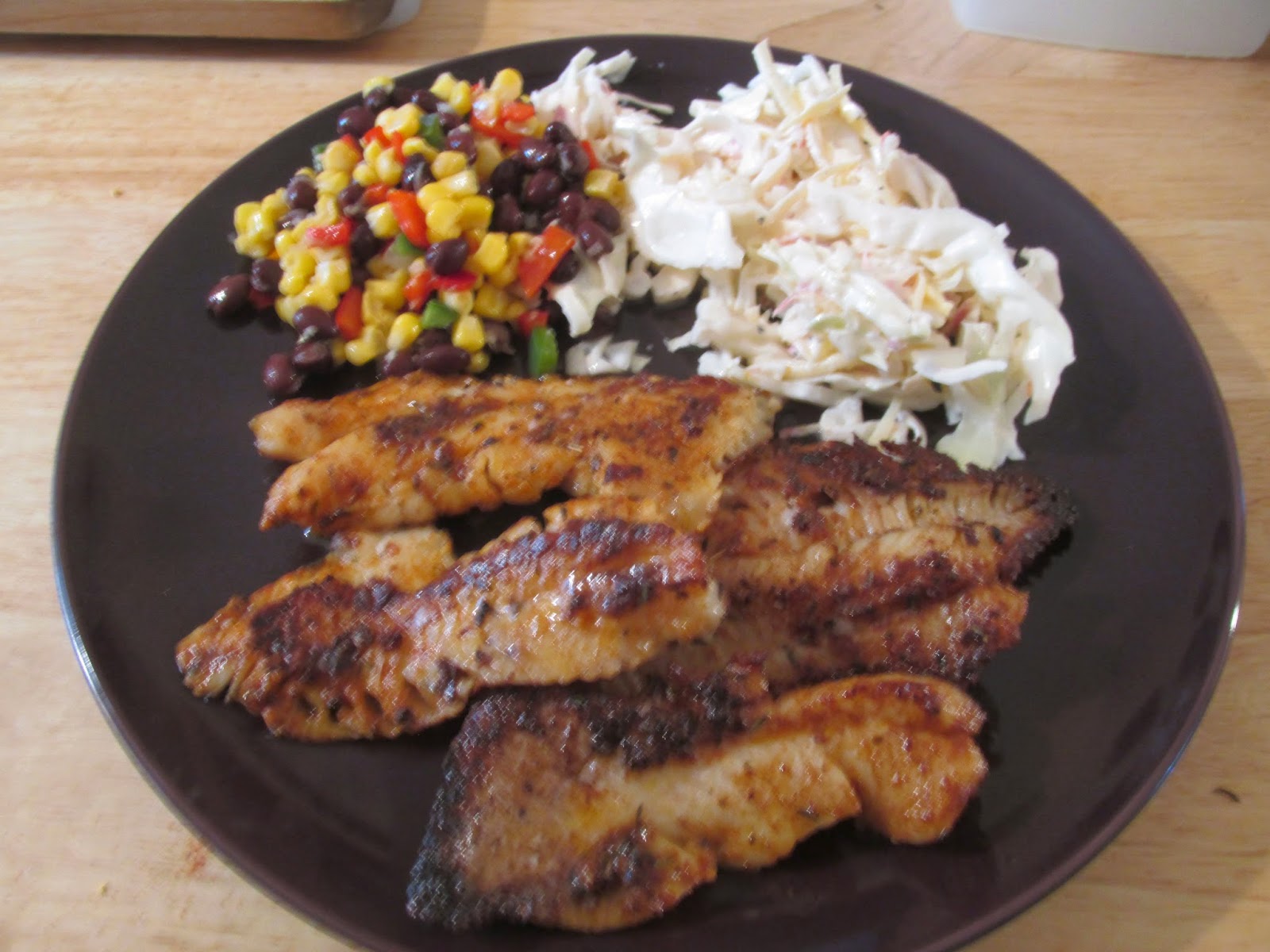
Almost charred. You may recognize the Thai bean salad,
and the creamy slaw is a tribute to our guest earlier
this week (and helps to cut the spiciness of the fish!)

Okay, my pan was smoking, and so were the fish and the butter. But I never reached blackened. Still, the fish tasted good, and was surprisingly moist, even though the filets were thin and the temperature was high. Must be all that butter.


Oh, yes, there's that book that came out this week! 

Nell Pratt doesn't go into details about her meals--she might be a bit distracted by the bodies she keeps finding. But I'll be in West Chester PA, where the story takes place, for a signing next week, and I'll be sure to check out the food scene.