Showing posts with label Julia Child. Show all posts

Tuesday, August 30, 2022

Tarragon Vinaigrette - #recipe by @LeslieBudewitz

LESLIE BUDEWITZ:  As I’ve written before, we truly discovered the glorious taste of tarragon on our first trip to France in 2009, where it particularly shone when served with chicken. When we returned home and began working our way through Julia’s Kitchen Wisdom by Julia Child, we knew we had to grow it ourselves. 

Kitchen Wisdom is the source of the recipe we call "Chicken Julia," great by itself and as the basis of other recipes, which is the guiding principle of the book. 


Now we keep a pot of tarragon on the deck and often keep the potted plant going through the winter, in the house. I’m finally brave enough to try planting it in the garden and seeing if I can turn it into a perennial; I’ll let you know how it goes.

This year’s plant is quite abundant but even so, as I cut stems and stripped leaves into a sieve for rinsing, I wondered if I really wanted to make a full recipe. Turns out, a cup of leaves adds up fast, and it wasn’t too much dressing at all. 

In addition to a lovely salad dressing, this vinaigrette—which isn’t terribly vinegar-y—went nicely on seared scallops, grilled white fish, and of course, chicken. It’s also a terrific dressing for a simple combo of halved cherry or grape tomatoes and white cannellini beans, and Lebovitz recommends it on grilled vegetables and mozzarella. 

Consider it the taste of a French summer, no matter where you live. 

Tarragon Vinaigrette 

adapted from David Lebovitz


scant 1/2 cup extra-virgin olive oil

1 cup loosely packed fresh tarragon leaves, rinsed

3 tablespoons red wine vinegar or sherry vinegar

1 teaspoon water

1 small shallot, peeled and sliced (about half the shallot pictured)

1 teaspoon Dijon mustard

1/2 teaspoon of sea or kosher salt

1/4 teaspoon honey (optional)

Put all the ingredients in a mini-chopper or blender. Pulse until well-mixed, with small flecks of green. Adjust seasonings—you may want a splash more vinegar or a dash more salt. Add the honey if you find the flavor of the tarragon slightly sharp. 

Makes a little over half a cup. 

Keeps in the refrigerator up to 5 days; bring to room temperature before serving.


Oops! Here's where the picture of the jar of vinaigrette would be if I'd remembered to take it! Just imagine, from the lovely green dressing poured over the scallops and the cucumber-watermelon-mozzarella salad pictured!


And as Julia would say, Bon Appetit!


PEPPERMINT BARKED: A Spice Shop Mystery (July 2022, Seventh St. Books)

From the cover: 
A Dickens of a Christmas turns deadly…

As the holiday season lights up Seattle’s famed Pike Place Market, Pepper Reece’s beloved Spice Shop is brimming with cinnamon, nutmeg, and shoppers eager to stuff their stockings. Add to the mix a tasty staff competition—a peppermint bark-off—along with Victorian costumes for this year’s Dickensian Christmas theme, and Pepper almost forgets to be nervous about meeting her fisherman boyfriend’s brother for the first time.

But when a young woman working in her friend Vinny’s wine shop is brutally assaulted, costumed revelers and holiday cheer are the last things on Pepper’s mind. Who would want to hurt Beth? Or were they looking for Vinny instead?

The vicious attack upsets everyone at Pike Place, but none more than Pepper’s own employee, Matt Kemp. At first, Pepper is baffled by his reaction, but his clandestine connection to Beth could hold the key to the assailant’s motive. Or perhaps it’s Vinny’s ex-wife who knows more than she’s letting on . . . and what about the mysterious top-hatted man with whom Pepper saw Beth arguing that morning?

As the secrets of the market come to light, long-held grudges, family ties, and hidden plans only further obscure the truth. Is it a ghost of the past rattling its chains, or a contemporary Scrooge with more earthly motives? As Pepper chases down a killer, someone is chasing her, and in the end, the storied market itself may hold the final, deadly clue.

A cozy holiday mystery full of culinary delights and a rich cast of characters, the sixth installment in the Spice Shop Mystery series will keep you turning the page . . . and reaching for another piece of peppermint bark. 


Leslie Budewitz is the author of the Food Lovers’ Village Mysteries and the Spice Shop Mysteries, and the winner of Agatha Awards in three categories. Death al Dente, the first Food Lovers' Village Mystery, won Best First Novel in 2013, following her 2011 win in Best Nonfiction. Her first historical short story, "All God's Sparrows," won the 2018 Agatha Award for Best Short Story. Peppermint Barked, her 6th Spice Shop mystery, will appear in July 2022, and Blind Faith, her second standalone suspense novel (written as Alicia Beckman), will release in October 2022. 

A past president of Sisters in Crime and a current board member of Mystery Writers of America, she lives in northwest Montana with her husband, a musician and doctor of natural medicine, and their cat, an avid bird-watcher.

Swing by Leslie's website and join the mailing list for her seasonal newsletter. And join her on Facebook where she shares book news and giveaways from her writer friends, and talks about food, mysteries, and the things that inspire her.


Thursday, June 2, 2022

Belgian Endive with Asparagus in a Creamy Sauce @LucyBurdette


LUCY BURDETTE: I have developed a thing for Julia--Julia Child that is. I realize I’m a little late to the party! I roared through the eight episodes of the new miniseries from HBOMax called Julia and loved every minute of it. (There are some reasonable complaints about how accurate their version of the story is, but after all it’s fiction—exactly like the books we write!)

 Once I’d finished watching the show, I went back and read MY LIFE IN FRANCE by Julia Child, written with her great nephew Alex Prud’homme. It’s an amazing story about a woman who started her life's journey not knowing how to cook anything, and became the expert on French food in the US and abroad, with multiple complex cookbooks to her name. So I’ve had French food on my mind, and when I saw fresh endive for sale at the farmers market I asked the question “what would Julia cook?“ Maybe it would have been something like this… 

Cook's notes: Most of the versions I've seen did not include asparagus, but we had some in the garden and I thought it would make a good addition. I prefer not to eat pork and ham, but my husband loves it. So I wrapped some of the endive in prosciutto and some in maple turkey.


Ingredients


Two large or three smaller endive heads

One cup shredded Gruyere cheese

One cup whole milk

2 tablespoons butter, unsalted

2 tablespoons flour

Half a teaspoon Dijon mustard

Sprinkle of nutmeg

Several slices of prosciutto or ham or maple turkey

Maybe a dozen spears of asparagus

Freshly ground pepper


The endives I bought were enormous, so I thought I'd better take the advice of several cooks online and steam the vegetables before baking the dish. Slice the endive lengthwise and steam them for 10 to 15 minutes until soft. Let them cool and drain on a dish towel.


Meanwhile, make a bechamel or cream sauce. Melt the butter in a small sauce pan, stir in the flour and mustard and whisk until smooth and thick. Slowly add the milk, whisking as you go, and continue to cook over low heat until thick. Take the pan off the heat and stir in the shredded cheese. Taste for salt, and add a shake of nutmeg.


Grease the pan and layer the asparagus spears on the bottom. Wrap each half endive in a slice of ham or turkey, and place on top of the asparagus. 


Pour the prepared sauce over the top of the vegetables, add several grinds of pepper, and bake at 375 for 15 minutes. 


Turn the heat up to broil, bake until bubbly and starting to brown. Serve with a nice green salad.


A DISH TO DIE FOR, #12 in the Key West food critic mystery series, will be out on August 9. 
Kirkus Reviews said: 
“Key West food critic Hayley Snow proves once again that she understands crime as well as cuisine. A suitably steamy background for a complex tale of murder and deceit.” 


About A Dish to Die For:

Peace and quiet are hard to find in bustling Key West, so Hayley Snow, food critic for Key Zest magazine, is taking the afternoon off for a tranquil lunch with a friend outside of town. As they are enjoying the wild beach and the lunch, she realizes that her husband Nathan’s dog, Ziggy, has disappeared. She follows his barking, to find him furiously digging at a shallow grave with a man’s body in it. Davis Jager, a local birdwatcher, identifies him as GG Garcia, a rabble-rousing Key West local and developer. Garcia was famous for over-development on the fragile Keys, womanizing, and refusing to follow city rules—so it’s no wonder he had a few enemies.

 When Davis is attacked in the parking lot of a local restaurant after talking to Hayley and her dear friend, the octogenarian Miss Gloria, Hayley is slowly but surely drawn into the case. Hayley’s mother, Janet, has been hired to cater GG’s memorial service reception at the local Woman’s Club, using recipes from their vintage Key West cookbook—and Hayley and Miss Gloria sign on to work with her, hoping to cook up some clues by observing the mourners.


But the real clues appear when Hayley begins to study the old cookbook, as whispers of old secrets come to life, dragging the past into the present—with murderous results.


Tuesday, January 19, 2021

Leek-Potato Soup #recipe @LeslieBudewitz

LESLIE BUDEWITZ: You might call it Potato-Leek Soup, but I’m channeling Julia Child today and she calls it Leek-Potato! We’ve been watching Julia’s 1985 “Way to Cook” videos, learning or relearning the simple but classic techniques she uses—everything from how to dice an onion or julienne carrots to boning a chicken. (Anyone who knows me well is laughing—I only shop at the boneless chicken ranch.) 

I love Julia’s honesty and her attitude. She isn’t precious about food. She loves cooking and eating and she is absolutely certain that anyone can learn to cook well. And when you watch her, you believe her. Because she’s Julia. 

French cooking carries a mysterious air, as if it’s all inscrutable technique or dishes that take all day. But it’s also good home-cooking. The amazing Dorie Greenspan, who writes cookbooks and often writes columns for the New York Times and is clearly steeped in the Julia Child tradition, says when Frenchmen were asked their favorite food in a survey, the winner was lentil soup. Probably more precisely, “my mother’s lentil soup.” 

I’ll save that one for later post. Today, it’s another simple classic, leek-potato. Or potato-leek.

A word about cleaning leeks: They look all shiny, like a day filled with white clouds and fresh green grass. Don’t be fooled. Tiny bits of sand and grit hide in those stalks. To clean them, trim the root end, then trim the greens so your leek is 6-7 inches long. Then slit it in half lengthwise, keeping the leaves intact. Rinse each half under cold running water, using your thumbs to spread the leaves and get the water into those hiding places. You may also toss the sliced leeks into a colander and give them another good rinse.

Serve with a simple green salad, a loaf of bread, and a glass of wine. Voilà!

Leek and Potato Soup

adapted from Julia’s Kitchen Wisdom: Essential Techniques and Recipes from a Lifetime of Cooking, by Julia Child

3 cups sliced leeks (white and tender greens, about 4 leeks)
3 cups Russet potatoes, peeled and chopped (about 3 small or 2 medium potatoes)
6 cups vegetable broth
1-1/2 teaspoon kosher salt
½ cup sour cream or crème fraîche
dill, dried or fresh, for garnish

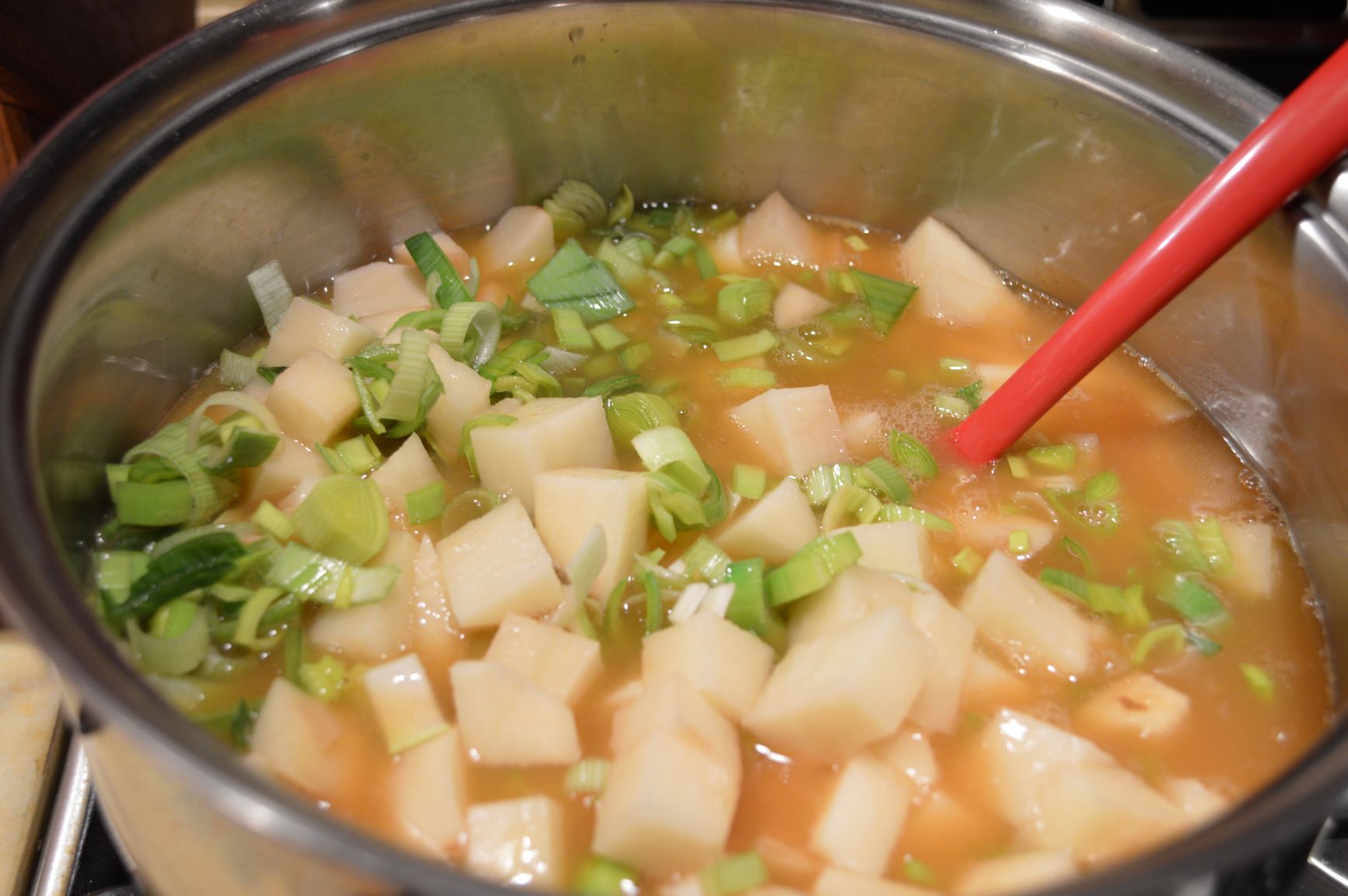
Place leeks, potatoes, broth, and salt in a stockpot and bring to a boil. Reduce to a simmer and cover partially until vegetables are tender, about 20-30 minutes. Taste and add salt, if necessary. 

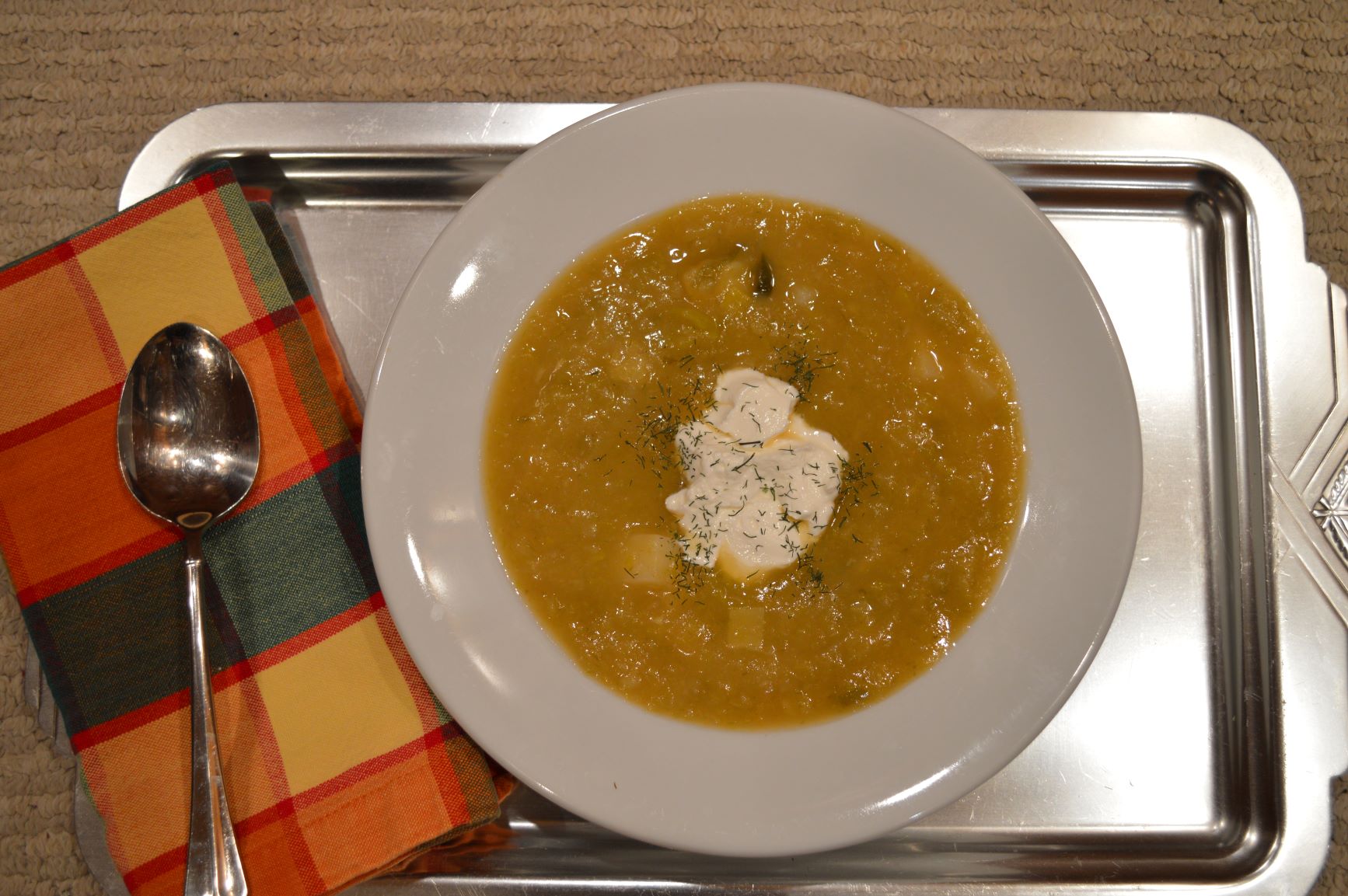
Remove from heat and use an immersion blender to puree the soup to your preferred thickness. (We like to leave some chunks.) Or use a standard blender to puree in batches; you may need to reheat the soup if you puree this way. 

Ladle into bowls and top each with a dollop of sour cream and a sprinkle of dill. 

Makes about 2 quarts, or 6-8 servings.


Enjoy!


From the cover of THE SOLACE OF BAY LEAVES, Spice Shop Mystery #5, out now in paperback, e-book and audio (Seventh St. Books and Tantor Audio) : 

Pepper Reece never expected to find solace in bay leaves. 

But when her life fell apart at forty and she bought the venerable-but-rundown Spice Shop in Seattle’s Pike Place Market, her days took a tasty turn. Now she’s savoring the prospect of a flavorful fall and a busy holiday cooking season, until danger bubbles to the surface ... 

Between managing her shop, worrying about her staff, and navigating a delicious new relationship, Pepper’s firing on all burners. But when her childhood friend Maddie is shot and gravely wounded, the incident is quickly tied to an unsolved murder that left another close friend a widow. 

Convinced that the secret to both crimes lies in the history of a once-beloved building, Pepper uses her local-girl contacts and her talent for asking questions to unearth startling links between the past and present—links that suggest her childhood friend may not have been the Golden Girl she appeared to be. Pepper is forced to face her own regrets and unsavory emotions, if she wants to save Maddie’s life—and her own. 

Leslie Budewitz is the author of the Food Lovers’ Village Mysteries and the Spice Shop Mysteries, and the winner of Agatha Awards in three categories. Death al Dente, the first Food Lovers' Village Mystery, won Best First Novel in 2013, following her 2011 win in Best Nonfiction. Her first historical short story, "All God's Sparrows," won the 2018 Agatha Award for Best Short Story. Watch for her first standalone suspense novel, Bitterroot Lake (written as Alicia Beckman) in April 2021 from Crooked Lane Books.

A past president of Sisters in Crime and a current board member of Mystery Writers of America, she lives in northwest Montana with her husband, a musician and doctor of natural medicine, and their cat, an avid bird-watcher.

Swing by my website and join the mailing list for my seasonal newsletter. And join me on Facebook where I announce lots of giveaways from my cozy writer friends.


Tuesday, July 17, 2018

Soupe au Pistou aka Pesto Soup

LESLIE: It’s summer time, and the veggies are thick in the garden patch and on the tables at the Farmer’s Market. While we think of soup as winter food, this one – a sort of summer minestrone – is perfect for a July evening.

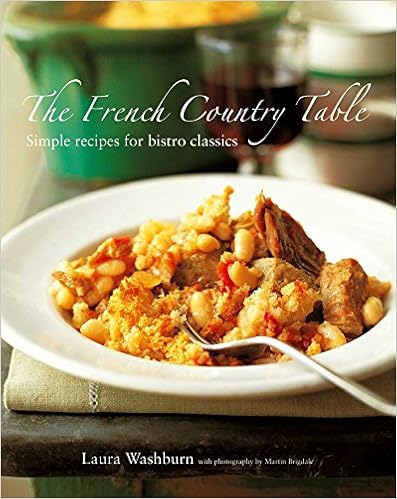
The recipe is based on one I found in The French Country Table by Laura Washburn, which I found at Book Passage in the Ferry Terminal building in San Francisco. Washburn falls in that long line of modern cookbook authors strongly influenced by Julia Child, though her recipes fall more on the bistro than the gourmet end of the French table. And they always turn out – they look like the photos and are well-written, but that hasn’t stopped me from making a few changes!

Washburn's notes say traditional Provençal cooks insist on Gouda because the soup was invented by Italian workers building the railway above Nice and used the Gouda which was plentiful in the port. Nonetheless, she calls for Gouda or Parmesan, and we’ve used only Parmesan.

In my opinion, canned beans are a pantry staple, though we do choose low-sodium varieties. Like most soups, the flavor improves if you can make this a few hours ahead and let it rest before serving. If not, you’ll still love it—and the leftovers will be terrific!

I’ve included Washburn’s pesto recipe, but will confess I very often use a spoonful or two of commercial pesto. And I didn’t bother blanching and skinning the tomatoes. The ghosts of Julia Child or those Italian railway workers haven’t come to haunt me yet, so I think the substitutions are safe.

Be French or Italian, and serve this with a loaf of crunch country bread and a crisp white wine.

Bon Appetit, as Madame Child would have said, and Madame Washburn would likely agree!

Soupe au pistou

Active prep and cooking time: about 1 hour.

3 tablespoons extra-virgin olive oil
1 small onion, chopped
1 small fennel bulb, quartered, cored, and chopped
2 zucchini, chopped
8 ounces new or small white potatoes, scrubbed and chopped
2 tomatoes, seeded and chopped
2 quarts vegetable or chicken stock
a sprig of thyme
2 cups (roughly 1-15 ounce can) cannellini beans, drained and rinsed
2 cups (roughly 1-15 ounce can) kidney beans, drained and rinsed
coarse sea salt and freshly ground black pepper
6 ounces green beans, cut in 1" pieces
2 ounces spaghetti, broken into pieces
1-1/2 cups grated cheese (aged Gouda or Parmesan)
basil leaves for garnish (optional)
more cheese for garnish (optional)
seasoned croutons for garnish (optional) (I made my own by tossing cubed bread with oil and dried herbs and toasting in the oven about 10 minutes)

Pistou 

4-6 garlic cloves 
½ to 1 cup of fresh basil leaves 
3 tablespoons extra-virgin olive oil
Heat the oil in a large saucepan or kettle. Add the onion, fennel, and zucchini and cook over medium heat for about 10 minutes, until browned. Add the potatoes, tomatoes, stock, and thyme. Bring to a boil and simmer about 10 minutes.

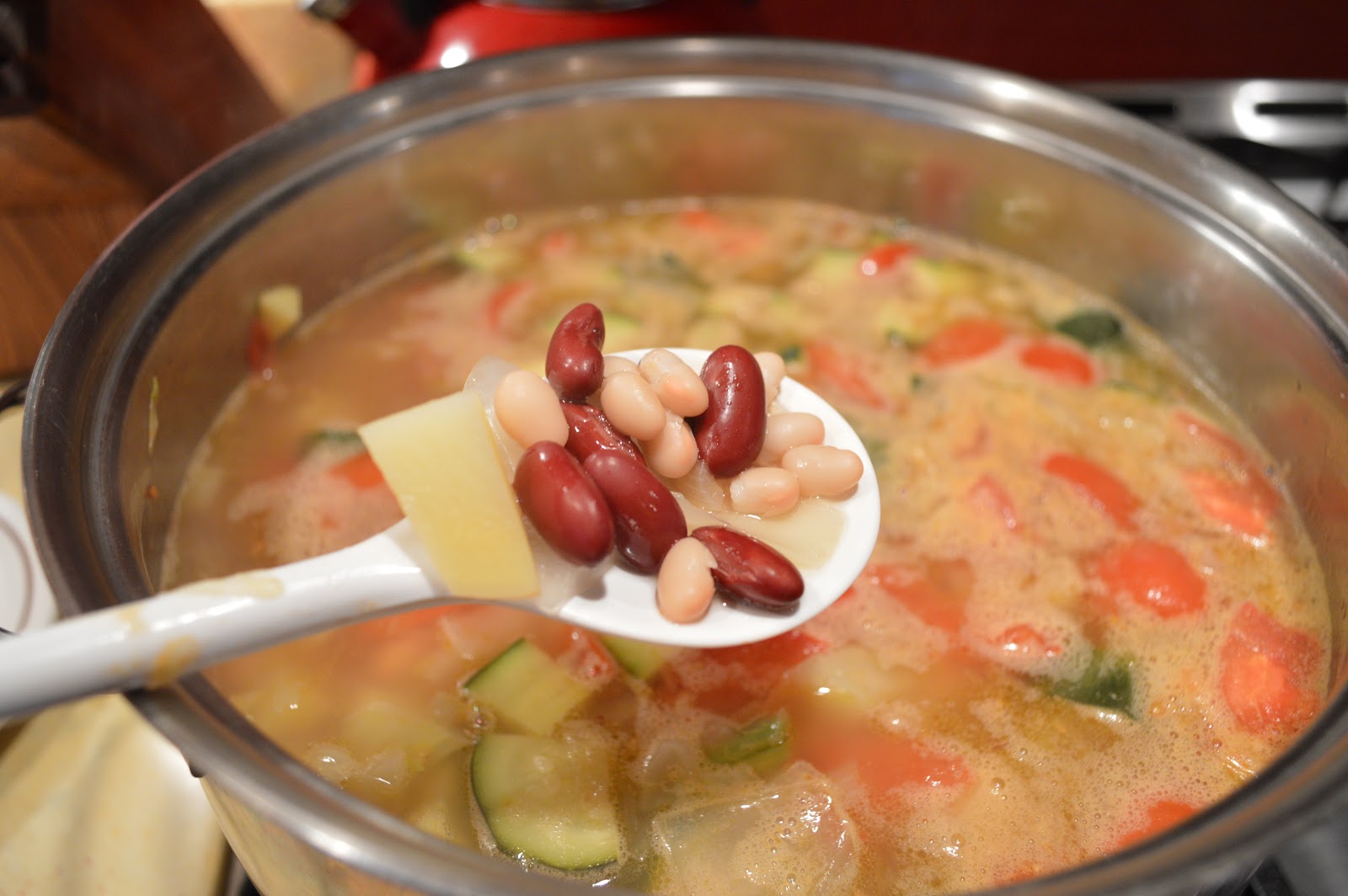
Add the cannellini and kidney beans and simmer, covered, for about 15 minutes. Taste and season with salt and pepper. Add the green beans and spaghetti and simmer about 10 minutes more, until the pasta is tender (al dente). Cover and remove from heat; let stand at least an hour and reheat, or serve at room temperature.

Just before serving, make the pistou. Put garlic, basil, and oil in a small food processor and process until well-blended. Add more oil if needed; you want a fairly thin pistou.

Top each bowl with a spoon of pistou or pesto, a basil leaf or two, and croutons if you’ve got them. Pass the bowl of cheese and enjoy! 


"Budewitz's finely drawn characters, sharp ear for dialogue, and well-paced puzzle make Jewel Bay a destination for every cozy fan." --- Kirkus Reviews


From the cover of AS THE CHRISTMAS COOKIE CRUMBLES, Food Lovers' Village Mystery #5 (Midnight Ink, June 2018, available in trade paper, e-book, and audio):  

In Jewel Bay---Montana's Christmas Village---all is merry and bright. At Murphy’s Mercantile, AKA the Merc, manager Erin Murphy is ringing in the holiday season with food, drink, and a new friend: Merrily Thornton. A local girl gone wrong, Merrily’s turned her life around. But her parents have publicly shunned her, and they nurse a bitterness that chills Erin.

When Merrily goes missing and her boss discovers he’s been robbed, fingers point to Merrily—until she’s found dead, a string of lights around her neck. The clues and danger snowball from there. Can Erin nab the killer—and keep herself in one piece—in time for a special Christmas Eve?

Leslie Budewitz is the author of the Food Lovers’ Village Mysteries and the Spice Shop Mysteries—and the first author to win Agatha Awards for both fiction and nonfiction. A past president of Sisters in Crime, she lives in northwest Montana with her husband, a musician and doctor of natural medicine, and their cat, an avid bird-watcher.

Swing by my website and join the mailing list for my seasonal newsletter. And join me on Facebook where I announce lots of giveaways from my cozy writer friends.


Friday, January 20, 2017

French Style Chicken

This past weekend my local paper’s magazine section had an article on how to cook chicken in various French-ish ways. I cook a lot of chicken, and I like French cooking, so I read on. [Please note that all parties shall remain nameless, because I disagreed with just about everything the author said.]

The author started out by claiming that a lot of cooks are still scared of exotic-sounding recipes, despite Julia Child’s eye-opening influence (which now dates back half a century! But I think they’re still the gold standard: she explains clearly and well, and the recipes work). The author claims that the dishes presented in the article are simple, if you know some basic techniques.

“Simple” is kind of a slippery idea. The author goes on to present recipes that are about as over-wrought as any contemporary ones that I’ve seen. We here at Mystery Lovers’ Kitchen love to give you new and interesting recipes from all sorts of sources, but we try to offer recipes that normal people can make. Maybe we take some shortcuts, but what we’re aiming for is tasty food that’s easy to put together.

This author missed the boat. Actual, the author lost me when author added sugar to the chicken. That was the first step in the recipe. Author then devoted ten lines to sautéeing boneless skinless chicken breasts. We do know how to do that, don’t we?

And so it went. Every step, every ingredient, was described to death, but not in a clear way. How the heck do you grate garlic (without grating your fingers)? What is a “strong simmer”? “Slightly reduced”? One instruction was to simmer something for 40 seconds. Do you keep a stopwatch by your stove?

Hey, it’s a recipe that sounds flavorful, so I gave it a shot anyway, translating it into normal cooking language—you know, “chop,” “mince,” “low heat,” “stir until thickened.” Instructions we can all understand. And it tasted just fine!


Sauteed Chicken French Style

The ingredients
The ingredients, chopped and measured
4 chicken breasts (note: you can use either boneless, skinless ones, which cook quickly, or bone-in, which I think taste better—just make sure they’re cooked through)

1 Tblsp vegetable oil
2 Tblsp butter
1/2 cup minced shallots
1 tsp fresh thyme
1 Tblsp minced garlic (about 4 cloves, depending on size)
1 Tblsp flour
3/4 cup dry white wine
1/2 cup chicken broth
1/2 cup heavy cream
1/2 tsp fresh lemon juice
3 Tblsp fresh parsley
Salt and pepper

In a large skillet heat the oil over medium-high heat until shimmering. Sautee the chicken until lightly browned, turning once. Set aside.

Will someone please explain to me why when
you buy a package with two pieces, they're
never the same size?

Reduce the heat, add the butter and let it melt. Add the shallots, thyme and a half tsp of salt and cook over medium-low heat until the shallots are soft. 


Add the garlic and flour and cook for about a minute.


Add the wine, scrape the pan to gather up all those tasty bits that stuck to it, and whisk until there are no lumps. Cook for about a minute longer, until the sauce is thickened. Add the broth and stir.

Return the chicken and any juices from it to the pan, dunk both sides in the sauce, cover and cook until the chicken is done [yanno, you can use a meat thermometer, or you can poke it to see how springy it is, but chicken breasts vary so widely in size that there’s no single right cooking time. Just make sure it’s not pink in the middle.]. Remove the chicken to a serving platter and keep warm while you finish the sauce.


Add the cream to the sauce in the skillet, turn the heat up to medium-high and cook until the sauce thickens. Remove from the heat and add the lemon juice. Taste and add salt and pepper if you like. Stir in the parsley. 


Pour the sauce over the chicken pieces and serve with rice (or a carb of your choice). To quote the immortal and pragmatic Julia Child, “Bon appetit!”

Looks a bit messy but it tastes good!


Cruel Winter (County Cork #5), coming in less than two months!

You may have noticed that Maura Donovan doesn't cook. But her young barmaid Rose does, and when a group of people get snowed in overnight at Maura's pub, Sullivan's in Leap, Rose dusts off the old kitchen in the back and feeds the crowd!

(And yes, it snowed in County Cork this month. It happens!)

Available for pre-order at Amazon and Barnes & Noble

www.sheilaconnolly.com