Showing posts with label Irish brown bread. Show all posts

Sunday, March 17, 2024

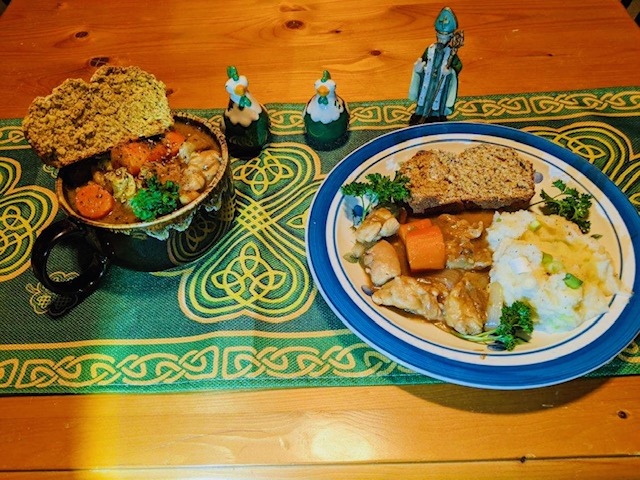
Chicken in Guinness with Mash from Guest Author Lisa Q. Mathews + Giveaway

KORINA MOSS here, excited to have my first Mystery Lovers' Kitchen guest, LISA Q. MATHEWS, sharing her recipe for a complete St Patrick's Day meal, plus a bonus leftovers breakfast! I'd say she's the perfect author to be joining us today. Read on to find out why! Be sure to comment to be entered in her Irish Giveaway!  
Happy St. Patrick’s Day, one and all! And thank you, Mystery Lovers' Kitchen, for inviting me to share my favorite holiday with you. The Jig is Up, the first book in the Irish Bed & Breakfast series, kicks off on August 20th—but it’s never too soon to start celebrating!

The bagpipes are calling and you’re donnin’ the green, ready to hit the parade. Unless…you somehow forgot to prepare the corned beef and cabbage yesterday. Or you’re still trying to banish last year’s fine aroma from your kitchen. No worries, here’s a delicious, hearty recipe that’ll have you ready for Paddy’s in a pinch—no need for the luck o’ the Irish or a prayer to St. Jude. Send the family off to save a spot at the parade, and Bob’s your uncle.

What you do need are a few simple, fresh ingredients and a can or two of Guinness to make this Irish version of coq au vin. It’s a modified version of the traditional Beef in Guinness, using chicken, which cooks faster. The alcohol burns off in the cooking, and if you don’t have Guinness on hand, you can substitute another beer (the Guinness does give a lovely taste, though.) No need to measure precisely, and if you prefer you can substitute simple boiled potatoes (add salt, butter, and parsley) for the mash. Every family has their own style of spuds, but this is our favorite—and thanks to early training, all of my kids are champion peelers. (My relatives in Ireland can peel with a knife faster than I can get a Good Grips peeler out of the drawer, but there you have it.)

Note: If you’re looking for a truly authentic taste of the Emerald Isle, Kerrygold butter is the way to go. Pure cream from happy Irish cows (all that rain and green grass to roam) and salt. Keep in mind that, due to its higher fat content, it melts faster, and you can use a wee bit less—but you won’t be sorry. (Fun fact: Kerrygold was banned in Wisconsin until 2017.)

Chicken in Guinness with Mash (serves 4)

Ingredients

(Chicken)

2.5 pounds boneless, skinless chicken thighs

2 yellow onions

6 medium carrots

Enough flour to coat the chicken 

Pepper 

¼ c butter 

2 c Guinness and water, mixed (more as needed)

Fresh parsley


Instructions

Peel and slice the onions and carrots. 

Cut chicken into chunks and toss in flour seasoned with pepper. (I shake the chicken in a brown paper bag and dump the chicken pieces into the pot, hands-free.)

Brown chicken quickly in hot butter in Dutch oven or other high-sided pot. 

Remove chicken into a bowl and fry onions until transparent. 

Return chicken to pot with onions, then add carrots and Guinness/water mixture.


Bring to a boil, reduce heat to a gentle simmer, cover closely and cook for about an hour. Check periodically to make sure the dish doesn’t dry out, adding more Guinness and water if needed. (I add a little more Guinness than water.) Sprinkle with fresh parsley before serving.


(Mash)

Ingredients

8-10 potatoes (Note: Rule of thumb is 2 medium spuds per person—but make it 3 and you’ll have leftovers. Mashed potatoes can be reheated (microwave works well if you add a little milk and stir-halfway through—but freezing is not recommended!)

1.5 c milk (I use 2%--with more added as needed for smooth consistency)

.5 c butter (more to personal taste, depending on number of spuds)

Sea salt if desired

Pepper

6-12 scallions/green onions (I don’t use the tops)

1 t nutmeg (to taste)


Instructions

Rinse potatoes in cold water, then peel and rinse again. Cut each potato into quarters, then cut any larger pieces so sizes are uniform (they’ll cook more evenly). Place in large saucepan and cover with cold water. Add water high enough so there’s liquid above the spuds, but not so high that the water is likely to boil over. 

Bring to a boil on medium-high heat, leaving the lid a bit open. Stir occasionally with a wooden spoon, so the spuds cook evenly in a crowded pot. Lower heat, and let spuds boil until soft and mushy when pricked with a fork. (It’s okay if the water is a little murky.)

Slice scallions and butter separately while potatoes are cooking and place aside.

Drain water from the pot. Use a potato masher to give the spuds an initial smash, then mash them with a dinner fork. (This prevents hard, uneven surprise lumps.) 

Add butter, a few slices at a time. Season potatoes with pepper (and sea salt if you’d like) and stir lightly with fork. Then start gradually adding the milk. Switch from fork to wooden spoon and stir, adding scallions.  Then sprinkle nutmeg in, a wee bit at a time—it really “perks” the potatoes. 

Serve chicken alongside or atop the potatoes, using plates or bowls. Garnish with parsley sprigs. Serve with Irish brown bread (it has a nuttier, less-sweet taste than soda bread).

I don’t have a bread recipe because…I use a mix, just like my relatives in Ireland! During my first visit I was amazed that delicious fresh bread was served at every meal. I couldn’t stop remarking on it. Upon my return home, I discovered a family member had tucked a package into my suitcase. It just happens that the Buckley family in The Jig is Up secretly uses the same shortcut at their bed & breakfast, The Buckley House. (And so does their big competition, The Smiling Shamrock across town in Shamrock, Massachusetts.)

There's a bonus to using mash instead of boiled potatoes: You’re halfway to a delicious Irish-style breakfast (a mini version) tomorrow. Just form those leftover spuds into paddy’s patties and fry them up with a few Irish bangers (I got mine online). Bring out that trusty brown bread and serve with Irish jam. Leave the dishes to family members or the kitchen fairies (more helpful than the other kinds). 

GIVEAWAY: Here's an Irish-themed giveaway for one lucky commenter, complete with an Irish tea-cozy, a tiny inspiring potato, bookmarks, and a package of Cadbury buttons. Giveaway open to US and Canada.

 Sláinte, and may the spirit of St. Patrick stay with you year-round!

Readers, how are you spending this fine St. Patrick’s Day?


Irish step dance takes a deadly turn in this Celtic cozy series debut, perfect for fans of Carlene O’Connor and Paige Shelton.

Single-mom and police chief’s daughter Kate Buckley is all about family. After she receives an urgent text from her younger sister Colleen, she puts her life on hold and rushes to her Irish-themed hometown of Shamrock, Massachusetts. With her two daughters in tow, she’s ready to fight if it means she can help her charming but hapless sibling.

When they arrive, Colleen claims it was all a misunderstanding. But everything changes in an Irish minute when Colleen’s best friend Deirdre, a dance show star, is found dead in the parish hall. With the discovery of a possible witness, a chilling motive, and a wee bit of incriminating evidence, Colleen quickly becomes a person of interest in Deirdre’s murder. Convinced her sister isn't a killer, Kate is determined to clear Colleen’s name.

As Kate investigates, Colleen takes charge of Shamrock’s popular Irish dance show in honor of her late friend–with disastrous results. With the St. Patrick’s Week festivities in full swing, Kate must catch the killer before the celebrations are ruined and her sister’s Irish luck runs out. 

Available for preorder here


LISA Q. MATHEWS began her publishing career editing Nancy Drew books. She also wrote for kids’ series such as Mary-Kate and Ashley and the Lizzie McGuire Mysteries. She now writes lighthearted mysteries for grownups with strong female characters and plenty of family, including the Irish Bed & Breakfast Mysteries (Book One, THE JIG IS UP debuts 8/20/2024) and the Ladies Smythe & Westin. Her short story “Fly Me to the Morgue” was an Agatha Award finalist. Lisa lives in New Hampshire. The “Q” in her name stands for “Quinn.”

Website & Newsletter: https://www.lisaqmathews.com/

Facebook Author Page: https://www.facebook.com/LisaQMathewsAuthor

Blog: https://chicksonthecase.com/

Instagram: https://www.instagram.com/lisaqmathews/

Goodreads: https://www.goodreads.com/author/show/14418623.Lisa_Q_Mathews

BookBub: https://www.bookbub.com/authors/lisa-q-mathews


Sunday, March 17, 2019

Guest Marian Stanley's Irish Soda Bread

Mystery Lovers' Kitchen is delighted to welcome author Marian Stanley with the perfect recipe for St. Patrick's Day!

VARIATIONS ON IRISH BREAD


I am partial to my mother’s Irish bread which is a cake-like white variety. My friend Jody often gifts us with a different one – a lovely Irish brown bread from her late husband Ed’s recipe. Our sister-in-law Kathleen makes a perfect traditional Irish soda bread but has no recipe for it. She just . . . does it. The very best part of the bread, says Kathleen, is the caila or the heel. I can’t find caila in the Gaelic dictionary. She doesn’t know how it should be spelled and why would that be important now, anyway? Perhaps it’s a County Louth term. In any case, Kathleen would be right – all that extra warm outer crust with sweet Irish butter is special.

Our friend Elaine brought a scrumptious soda bread over to our back door for Christmas too. The one we chose to share, however, is this one - called the Marilyn O’Reilly Soda Bread, by way of our daughter Katherine, who makes a delicious round. I couldn’t decide on which of these variations of Irish bread would be featured in my WIP, The Mariposa Circle, but I think it could be this one.

Served with a pot of Barry’s Irish tea – in the pot prepared beforehand with an extra rinse of hot water, sweet Irish butter and a good marmalade. I like Dundee.

IRISH SODA BREAD

Ingredients:

3 cups all-purpose flour

1/4 cup sugar
1 tablespoon baking powder
1 teaspoon baking soda
1/2 teaspoon salt
4 tablespoons unsalted butter
4 tablespoons caraway seeds (optional)
1 cup raisins
1 cup buttermilk
1 egg


Directions:

Set rack in the middle level of the oven and preheat to 400 degrees.

In a mixing bowl, combine flour, sugar, baking powder, baking soda and salt. Stir to mix.

Add butter and cut/rub in until butter disappears into the dry ingredients.

Stir in raisins and, if chosen, caraway seeds.

In a small bowl, mix together the buttermilk and egg. Mix into the dough mixture with a rubber spatula.

Turn the dough onto a floured surface and fold over on itself several times to make a round loaf. Transfer to a cookie sheet or jelly roll pan covered with aluminum foil and cut a cross on the top. 


Bake for 15 minutes and then reduce heat to 350 degrees and cook for about 15 or 20 minutes more, Toothpick test center.

Cool on a rack and serve with butter and marmalade.


Like her protagonist Rosaria in The Immaculate, Marian McMahon Stanley enjoyed a long international corporate career with a Fortune 500 company and, more recently, a senior position at a large, urban university in Boston. She is the mother of four adult children and a growing number of grandchildren. Marian writes in a small, bookish, historical town west of Boston and on Cape Ann in Gloucester, the nation’s oldest seaport. She lives with her husband Bill and — just as in the story — a Westie named Archie.

Buried Troubles is Marian's most recent book, and she's hard at work on the next, The Mariposa Circle.

Find out more on her website

Marian is giving away a copy of Buried Troubles. Just leave a comment below (with your email address), and answer the question, "Have you ever made Irish bread?"


Friday, September 21, 2018

Irish Brown Bread--The Final Solution

Yes, I’ve written about this before, more than once. I love to eat the whole-grain kind, with some good Irish butter and a dollop of black currant jelly. 

The thing is, I can’t make the stuff. I’ve been collecting recipes for nearly twenty years, from a wide variety of sources (including my former Irish language teacher, who didn’t even use a recipe because she didn’t need one after making it for seventy-plus years). I have a spreadsheet with fourteen brown bread recipes, all of which I have tested myself. Funny thing—they’re all slightly different. 
This is just half the recipes!
But quite recently I discovered something. The Boston Globe printed yet another brown bread recipe this summer, which I dutifully saved. But when I read it, I realized I had missed an important element: how to bake it. The recipe author Sheryl Julian pointed out that historically Irish homes had only open fires to cook over, and meals were made in a hanging iron pot over the fire. 

I can attest to this because I’ve visited what’s left of the Connolly family home in West Cork, which was built in 1907, according to my second cousin, who was born in that house. It had a large open fireplace, and an iron crane to hold the cooking pot over the fire.
The house was abandoned in 1956, when the
family moved to a larger farm. My great-grandmother
Bridget spent her last years here.
The final clue was: cover the pot for the first part of cooking the bread (the old iron pots had lids) and open it only for the last part of the baking, to brown the top crust. 

My breads have too often turned out dry and sort of tasteless. By covering the bread, it keeps it moist. Eureka!

I haven’t tried all my collected brown bread recipes using this method (nor do I have a giant fireplace with a hanging crane and a cast-iron Dutch oven), but I’m pretty sure the method is forgiving, as long as your fire, er, oven is hot enough to cook it through. I should also note that you should try to get hold of some coarse-grain whole-wheat (or wholemeal) flour if you want an authentic texture and flavor.

Irish Brown Bread (thanks to Sheryl Julian)

Ingredients (for one large round loaf):


3 cups whole-wheat flour (I used Odlum’s Extra Coarse Wholemeal)
1-3/4 cups all-purpose flour
1-1/2 tsp salt
1-1/2 tsp baking soda (I have some Irish “bread soda”)
4 Tblsp butter, cut into small pieces, at room temperature
2 cups buttermilk

Instructions:

Preheat the oven to 425 degrees F. (If you have an open fire, I have no clue what you should do!)

If you have a round Dutch oven with a lid, you’re lucky. But you can also use a cast-iron skillet and cover it loosely with foil, as long as it measures 8-1/2 to 9 inches across (it doesn’t matter how deep it is). Butter your pan and dust it with flour.

In a large bowl, mix the two flours, salt and baking soda with a pastry blender or two knives.


Add the butter and work it into the flour until the mixture forms coarse crumbs.


Stir in the buttermilk with a rubber spatula, until the mixture holds together.


Turn out your dough on a flour countertop or board and cut through it with the spatula to make sure it’s evenly mixed. Knead the dough gently until it is smooth (do not over-knead—this is not yeast dough). It will be sticky! 


Shape it into a large ball (tuck any edges underneath). With a sharp knife, slash a cross about 3/4” deep on the top. Place the loaf into your prepared pan.

Cover the pan (as noted, if it’s a skillet, loosely cover it with foil) and place in the middle of your preheated oven. Bake for 10 minutes.


Reduce the oven temperature to 400 degrees and keep baking for another 30 minutes (take a peek at the loaf—it should be lightly browned).


Remove the lid or foil and bake for another 10 minutes, until the top is well browned. To test for doneness, tap your knuckles on the bottom of the loaf—it should sound hollow.


Place the loaf right side up on a wire rack to cool. To serve it, cut into thick slices (thin slices are likely to crumble apart) with a serrated knife.


I’m happy to say that this baking method made a real difference. So does the very coarse wholemeal flour. Maybe I’ve finally got it right?


Still working on the novella that's coming shortly, so you'll have to content yourself with the lovely cover for the next book, The Lost Traveller, due out in January.


And a thoroughly silly picture of me with a
pair of cabbages (grown by my neighbor)


Friday, August 14, 2015

Bailey's Irish Soda Bread Ice Cream

by Sheila Connolly

My sister sent me this recipe around Saint Patrick’s Day. She found it in a magazine. But March this year was not a good time for ice cream in New England (several feet of snow on the ground), so I decided to save it for summer, when it might be warmer. It is!

So let’s pretend we’re celebrating Lúnasa, the traditional Irish festival that marks the start of the harvest, and falls midway between the summer solstice and the autumnal equinox. Or for the sake of simplicity, somewhere around August 1st. Close enough!

My own bread--it tastes better than it looks!

First you have to find some Irish soda bread—the brown, wholemeal kind. Most stores don’t have it, but you can make your own. I think I have thirteen recipes for it now, and I’m not happy with any one of them, but I do keep trying. The one I used worked as well as any. If you can’t find it and don’t feel like making your own (baking = hot!), find a fairly dense wholemeal bread and proceed with the recipe, although you could throw some oats in to add texture.


Bailey’s Irish Soda Bread Ice Cream

5 oz bread crumbs from Irish soda bread
1/3 cup light brown sugar, packed
1 cup whole milk
1 cup heavy cream
3/4 cup granulated sugar
1 tsp vanilla extract
Pinch of salt
5 egg yolks
1/3 cup Baileys Irish Cream liqueur


Preheat the oven to 350 degrees.

Mix bread crumbs and brown sugar together, then spread the mixture evenly on a baking sheet. Bake about 10 minutes or until the bread crumbs are lightly browned and the sugar has melted (stir occasionally while baking) and the whole thing feels kind of gluey. Let cool.


Pour the milk and cream into a saucepan, place over medium heat, and stir in the granulated sugar and a little salt.  Keep stirring until the sugar has dissolved (the mixture should be warm, not hot!). Remove from heat.


In a large mixing bowl, lightly beat the egg yolks. Gradually add the warm milk mixture, beating gently to combine. Transfer the mixture back to the pan and place over low heat. Add the vanilla. Cook, stirring constantly, until the mixture thickens to a custard consistency (heck, mine never made it past chowder consistency, but it was thicker than it started).


Remove the pan from the heat and stir in the Baileys, along with the cooled bread crumbs. Mix well.

The original recipe said to pour the mixture into a freezer-proof container and freeze overnight, stirring a couple of times so it doesn=t form a solid block. Well, I’ve been keeping the freezing container of my cute little ice cream maker in the freezer for, oh, years, so I figured I might as well use it. Yes, I did crank it a few times, and I left it in the freezer for 24 hours.


I don’t think that it will ever get hard, but it’s hard enough. The texture is interesting. I don’t know if it’s ice cream—maybe you could call it a frozen pudding? With bread crumbs? Either way, it tastes good.


Makes 2-1/2 cups.


A Gala Event is coming out October 6th!

Pre-order it at Amazon (where for some reason it's currently on sale for $4.37, but I don't know for how long because nobody tells me these things) or Barnes and Noble.

And eat more ice cream!