Showing posts with label lemons. Show all posts

Wednesday, April 2, 2025

Nigella's Lemon Pavlova #Recipe by @LibbyKlein #Easter #Mother's Day

Libby Klein I've followed Nigella Lawson since Nigella Bites. The mid nineties to early two thousands was the heyday for traditional cooking shows before they turned into competitions and Nigella was one of my favorites. I've tried to win that signed cookbook to no avail, and I make her carbonara recipe whenever we feel we need a special meal. I can't order it in a restaurant because half the time it comes as scrambled egg pasta and it's too easy to get it right on my own. Nigella has spoiled me. 

When I saw this recipe for Lemon Pavlova I saved it in my must make folder for a special occasion. The special occasion that finally arrived was it's snowing and I've been sick so I want a treat. So here we are. This makes 8-12 slices and it doesn't keep fresh for very long so maybe wait until you have an event or dinner party to roll it out. You can make the merengue base a day ahead. This would make a perfect dessert for a spring event like Easter or Mother's Day.


Lemon Pavlova by Nigella Lawson

Yield 8-12

Ingredients

6 egg whites
375 grams of caster sugar (2 1/4 cup of fine granulated sugar)
2 1/2 teaspoons corn flour (corn starch)
2 unwaxed lemons (are lemons usually waxed?)
50 grams flaked almonds (1/2 cup sliced almonds)
300 milliliters double cream (1 1/4 cup heavy whipping cream)
325 gram jar lemon curd (I personally like Tiptree but any kind you like will do)

Directions (I'm going to post these exactly as Nigella wrote them because they're kind of fabulous)

1.     Preheat the oven to 180°C/160°C Fan/gas mark 4/350°F and line a baking tray with baking parchment. Beat the egg whites until satiny peaks form, then beat in the sugar a spoonful at a time until the meringue is stiff and shiny.

2.     Sprinkle the cornflour over the meringue, then grate in the zest — a fine microplane is best for this — of 1 lemon and add 2 teaspoons of lemon juice.

3.     Gently fold until everything is thoroughly mixed in. Mound onto the lined baking tray in a fat circle approximately 23cm/10inches in diameter, smoothing the sides and the top with a knife or spatula.

4.     Place in the oven, then immediately turn the temperature down to 150°C/130°C Fan/gas mark 2/300°F, and cook for 1 hour.

5.     Remove from the oven and leave to cool, but don’t leave it anywhere cold as this will make it crack too quickly. If you think your kitchen is too cool, then leave the pavlova inside the oven with the door completely open. When you’re ready to eat, turn the pavlova onto a large flat plate or board with the underside uppermost — I do this before I sit down to the meal in question and let it stand till pudding time. This is so the tender marshmallow belly of the pav melds with the soft topping.

6.     Toast the flaked almonds, by frying them in a dry pan over a medium to high heat until they have started to colour. Shake the pan at regular intervals and don’t let them burn. This doesn’t take more than a minute or so. When they’re done, remove to a cold plate so that they don’t carry on cooking.

7.     Whip the cream until thick and airy but still with a soft voluptuousness about it, and set it aside for a moment.

8.     Put the lemon curd into a bowl and beat it with a wooden spoon or spatula to loosen it a little. Taste the lemon curd (if it’s shop-bought) and add some lemon zest and a spritz of juice if it’s too sweet.

9.     With a light hand, a glad heart and a spatula, spread the lemon curd on top of the meringue base. Now top with the whipped cream, peaking it rather as if it were a meringue topping. Sprinkle with the zest of the remaining lemon — you can grate this finely or coarsely as you wish — followed by the flaked almonds, and serve triumphantly.


Vice and VirtueLayla Virtue, a blue-haired, 30-something recovering alcoholic and former cop is trying to reinvent herself as a musician—between AA meetings, dodging eccentric neighbors at her trailer park, and reconnecting with her mysterious dad—in this ​unforgettable new mystery brimming with hilarity and heart.


Layla is taking her new life one day at a time from the Lake Pinecrest Trailer Park she now calls home. Being alone is how she likes it. Simple. Uncomplicated. Though try telling that to the group of local ladies who are in relentless pursuit of Layla as their new BFF, determined to make her join them for coffee and donuts.

After her first career ended in a literal explosion, Layla’s trying to eke out a living as a rock musician. It’s not easy competing against garage bands who work for tacos and create their music on a computer, while all she has is an electric guitar and leather-ish pants. But Layla isn’t in a position to turn down any gig. Which is why she’s at an 8-year-old’s birthday party, watching as Chuckles the Clown takes a bow under the balloon animals. No one expects it will be his last . . .

Who would want to kill a clown—and why? Layla and her unshakable posse are suddenly embroiled in the seedy underbelly of the upper-class world of second wives and trust fund kids, determined to uncover what magnetic hold a pudgy, balding clown had over women who seem to have everything they could ever want. Then again, Layla knows full well that people are rarely quite what they seem—herself included . . .

Silly Libby
Libby Klein grew up in Cape May, NJ where she attended high school in the '80s. Her 
classes revolved mostly around the Culinary sciences and Drama, with one brilliant semester in Poly-Sci that may have been an accident. She loves to drink coffee, bake gluten-free goodies, collect fluffy cats, and translate sarcasm for people who are too serious. She writes from her Northern Virginia office where she serves a very naughty black smoke Persian named Sir Figaro Newton. You can keep up with her shenanigans by signing up for her Mischief and Mayhem Newsletter on her website. 
www.LibbyKleinBooks.com/Newsletter/


Sunday, May 16, 2021

Sunday Brunch: what are your favorite ingredients? #giveaway


MARY JANE MAFFINI  Welcome to our monthly Sunday Brunch conversation in which we chat merrily among ourselves and with our lovely readers.  No surprise that the topic is often food.  One of the joys of being part of Mystery Lovers Kitchen is the variety of food, flavors and approaches in our posts.  We live in different parts of the US and Canada. We bring varied backgrounds and influences to ‘the kitchen’ and it shows up in a fantastic range of recipes.  I never get bored reading MLK and over the years I have happily enjoyed dozens of my colleagues’ recipes and tips. 

Brunch is all about flavor and fun!  Today I’m curious about what flavors (herbs, spices, ingredients) you love and rely on in your kitchen, whether you’re baking, making a main dish, a salad or whatever.  I’m leaving out flour, salt and pepper, although feel free to argue that point.


 I was chatting recently about this with my friend, Linda Wiken aka Essie Lang (who was until recently part of MLK). Linda keeps a live basil plant in her kitchen all year long, replacing that plant whenever she needs to. Great idea, Linda. I think I’ll steal it.

In my own kitchen, I'd be lost without lemon, garlic, green onions, thyme, paprika and butter.  On the sweet side, lemons again, toasted almonds, vanilla and Penzey’s cocoa.    

I asked my daughters what ingredients they associated with my kitchen. I then had to dial it back to assure them there were no wrong answers! After a lot of thought my daughter Virginia said, "Toasted almonds, vanilla and lemon."

Victoria said, 'Lemon and cheese' without missing a beat. Good catch because lemons are in everything and cheese shows up in mains, salads and desserts. I did wonder why no one has even noticed all that thyme over the years.   

My mother and my mother-in-law were both inspired cooks and there was often a delicious hint of lemon in their wonderful meals.

I've had many lemon-influenced recipes here on Mystery Lovers Kitchen over the years. Here's a link for Lemon Meringue Tiramisu  from a few years back. 

So, now my friends, what are the ingredients (and flavors) you love and can’t live without?  I hope you readers will join in and share your favorite flavors because there will be a fabulous book giveaway for some lucky commenter.  


🍅🍅🍅


VICKI DELANY:   I'd say it depends on the season. Unquestionably tomatoes and basil in late summer and fall.  I love little more on earth than a fresh sun ripened tomato. When they're in season, I cook with them all the time, and more often than not using fresh basil as well.  Here's a link to a pasta made with fresh tomatoes that I make quite a lot. ( Mystery Lovers' Kitchen: Summer pasta (mysteryloverskitchen.com). I also use that abundance of tomatoes and basil to make tomato soup and pasta sauces to freeze to enjoy over the long dark winter.

During that long dark winter, you'd likely find me using curry powder, cumin, garam masala., and chili spices as well as plenty of hot peppers. I love a nice rich curry and I often make big batches in my slow cooker to enjoy over several meals. 

🍋🌿🌽


LESLIE KARST: One word: CUMIN! It’s amazing how much of this spice—in both its powdered and whole seed forms—I go through in a year. Perhaps because I grew up in Southern California on a diet of Mexican cuisine, the craving for comino seems to be in my blood: that warm, earthy flavor, with a hint of citrus, leather, and pepper. But as I started to branch out in my cooking adventures, I soon realized that cumin is also a key ingredient in other cuisines, such as Indian and Middle Eastern foods. (In fact, it originated in the Levant thousands of years ago, and was brought to Latin America by Spanish and Portuguese colonists.) For one of my favorite Mexican recipes using cumin, try these Calabacitas, and for an Indian-inflected meal using the spice, this Turkey Tikka Masala is terrific.


🍕🍕🍕


LESLIE BUDEWITZ: I have been thinking, thinking, thinking: Is there a flavor profile, as the pros say, that defines our kitchen and cooking? Honestly, I have to say no. Like Vicki, we play up the bright, fresh flavors of the summer and fall, which means lots of tomatoes and summer squash and fresh herbs. This past winter, we went on a French cooking spree, heavy on the shallots, tarragon, and a splash or two of white wine. When I scroll down my list of posts, I see that herbs and spices often predominate -- Ginger Spice Muffins and Chai Spice Coffee Cake -- which makes sense not just because I write the Spice Shop mysteries but because it was visits to sniff and grab a cup of spice tea at Market Spice in Pike Place Market as a college student and later a young lawyer working in downtown Seattle that got my spice buds drooling. Fresh herbs add big flavor and often, color, that we love, as in these Cheddar Rosemary Crackers and this Roasted Mushroom, Tomato, and Herb Salad. Bottom line: If you come to our house, you might get French food, Italian, Greek, Indian, Chinese, or distinctly American, but you can count on getting LOTS of flavor! 


🍪🌿🌼


LUCY BURDETTE: This is not so easy to answer MJ! I will have to go with unsalted butter, cheddar cheese, onions, hot sauce, and whatever's in the garden. Here's an example that's easy and so so delicious: Scottish cheese shortbread. So delicious that I could be tempted to sneak the entire plate myself...


🍅🌿🍆

MADDIE DAY: I love this topic! I grow garlic every year, so it's always in the kitchen. Like Leslie K, this native southern Californian also loves cumin. Like Lucy, we always have a big block of Seriously Sharp Cabot cheddar for things like Cheesy Biscuits, and like Mary Jane, I keep a live herb plant inside all winter, but mine is rosemary. I also always have Asian condiments at hand: sesame oil, soy sauce, rice vinegar, and more, so I can throw together an Asian noodle salad


And like all of us, fresh produce in season! A BLT or a Caprese salad when the tomatoes are sun ripened in my garden? Can't be beat. When tomatoes are in abundance, I roast them with garlic and olive oil and whiz them into a sauce, which I freeze for the winter. I pick a few dozen pounds of blueberries every summer and freeze them for use all year long. 


☕ ☕ ☕


CLEO COYLETwo words for you, chocolate and coffee! Of course, after nearly 20 years writing the Coffeehouse Mysteries, the “coffee” part of that answer should be no surprise.


Cleo's Chocolate Ricotta Muffins
click the photo for the recipe!
We love using coffee and chocolate in our cooking and baking, whether we’re marinating steaks for the grill (using brewed coffee) or deepening the rich flavor of chocolate in our Chocolate Ricotta Muffins (via a little instant espresso powder). 

Right now, Marc and I are finishing up our upcoming Coffeehouse title HONEY ROASTED, which adds another amazing ingredient to our answer for you because we've enjoyed using honey in our kitchen for years. Stay tuned for a deliciously fun new Clare and Co. culinary adventure! ~ Cleo 


🍓🌷🍒


PEG: This  topic makes me think of my grandmother--her house always smelled like basil.  Whenever I smell the herb, I immediately think of her.  Personally, I can't cook without garlic and onions.  No, I mean it.  I put garlic and onions in virtually everything (except desserts, of course!)  When it comes to spices, chili powder and cumin are a must since many of hubby's favorite dishes require one or both.  And I always keep a bag of lemons on hand--they brighten everything and are the star in many other recipes as well--for instance, the lemony Madeira cake I made recently. 


🍋🍋🍋

TINA KASHIAN: I love this topic for our Sunday brunch! Mediterranean and Middle Eastern cooking often starts with extra virgin olive oil, garlic, onions, and freshly squeezed lemon juice. These ingredients, minus the onions, go into my hummus recipe. Next would come vegetables, beans, and whole grains like bulgur. Cooking tastes best when it's fresh, flavorful, and healthy. And along with Mary Jane Maffini, freshly squeezed lemon juice is my favorite ingredient. I guess great minds think alike! 
 

🍴

MAYA CORRIGAN: Butter, garlic, onions, yogurt, and crusty bread are staples in our house. At the moment, we have nine different fruits in the house for two of us, and that's typical. As for spices, we love Old Bay Seasoning, which originated in Baltimore. My Five-Ingredient Mysteries are set in the Chesapeake Bay area, where this seasoning is used liberally on crabs, shrimp, chicken, and fish, as well as corn and fries (Chesapeake fries, not French fries). In the early 1990s, McCormick took over marketing Old Bay, so it's more readily available outside the Mid-Atlantic than it used to be. In looking over the recipes on Mystery Lovers' Kitchen, I noticed a number that Lucy posted with Old Bay as an ingredient, and tomorrow I'll be posting one for a local Chesapeake specialty: peel 'n eat shrimp. 


 GIVEAWAY!


To be entered in this week's drawing,
leave a comment (with your email address) 
to join our discussion:

What are the ingredients (and flavors)
you love and can’t live without?  

Comments Open through
Wednesday, May 19.


>  NO GRATER CRIME by Maddie Day
(Advanced Reading Copy) 

>  ORGANIZE YOUR CORPSES
by Mary Jane Maffini 

>  HUMMUS AND HOMICIDE
by Tina Kashian 


Comments Open through
Wednesday, May 19

🌷


Friday, April 27, 2018

Digging up the Past

We here at MLK have been blogging for quite a while now, with some guests popping in, and we’ve posted over two thousand recipes. Yikes! How did that happen?

It’s interesting to see how recipes and cooking have changed since we started writing this blog. I was looking for inspiration this week and turned to my own saved recipe folder—which goes back to the year 2000 (long before MLK!). It includes a real hodgepodge of recipes—from magazines like Bon Appetit, to which I subscribed for a few years, to contributions from friends (one shared three excellent cheesecake recipes), to a few “where the heck did this come from?” recipes.

I went back to the very beginning, and found a nice and fairly simple recipe for chicken. Of course, if you follow MLK you know that we always have to do some tweaking, and that was true here. The original recipe called for chicken cutlets (does anyone use that term any more?), but I substituted a Cornish game hen (which is really just a small chicken). One of those feeds two people nicely, and I used the full recipe for the rest of of the ingredients.


A Cornish game hen. Tiny, isn't it?
Can you tell how things have changed since 2000? Answers at the end.


Classic Lemon Chicken

Ingredients:


2 lemons 
4 chicken cutlets (or one Cornish Game Hen)
salt and pepper 
flour for dredging
6 Tblsp. extra-virgin olive oil 
6 Tblsp. butter 
2 cloves garlic, peeled and minced 
2 Tblsp. capers
1/2 cup dry white wine 
1 cup chicken stock or broth 
2 Tblsp. chopped parsley


Instructions:

Squeeze the juice from one and a half lemons and reserve. Cut the remaining half lemon into very thin slices. Remove the seeds and set the lemon slices aside. 

Season the chicken pieces with salt and pepper. Dredge the pieces in flour, coating both sides, and tap the excess flour off. 


Heat 3 tablespoons of olive oil and 2 tablespoons of butter in a large skillet over medium heat. Add the chicken pieces and cook until golden brown, approximately 3 minutes. Flip and cook the second second side until lightly browned, about 2 minutes. Remove the chicken and drain on paper towels. Wipe  the remaining fat from the skillet with paper towels.


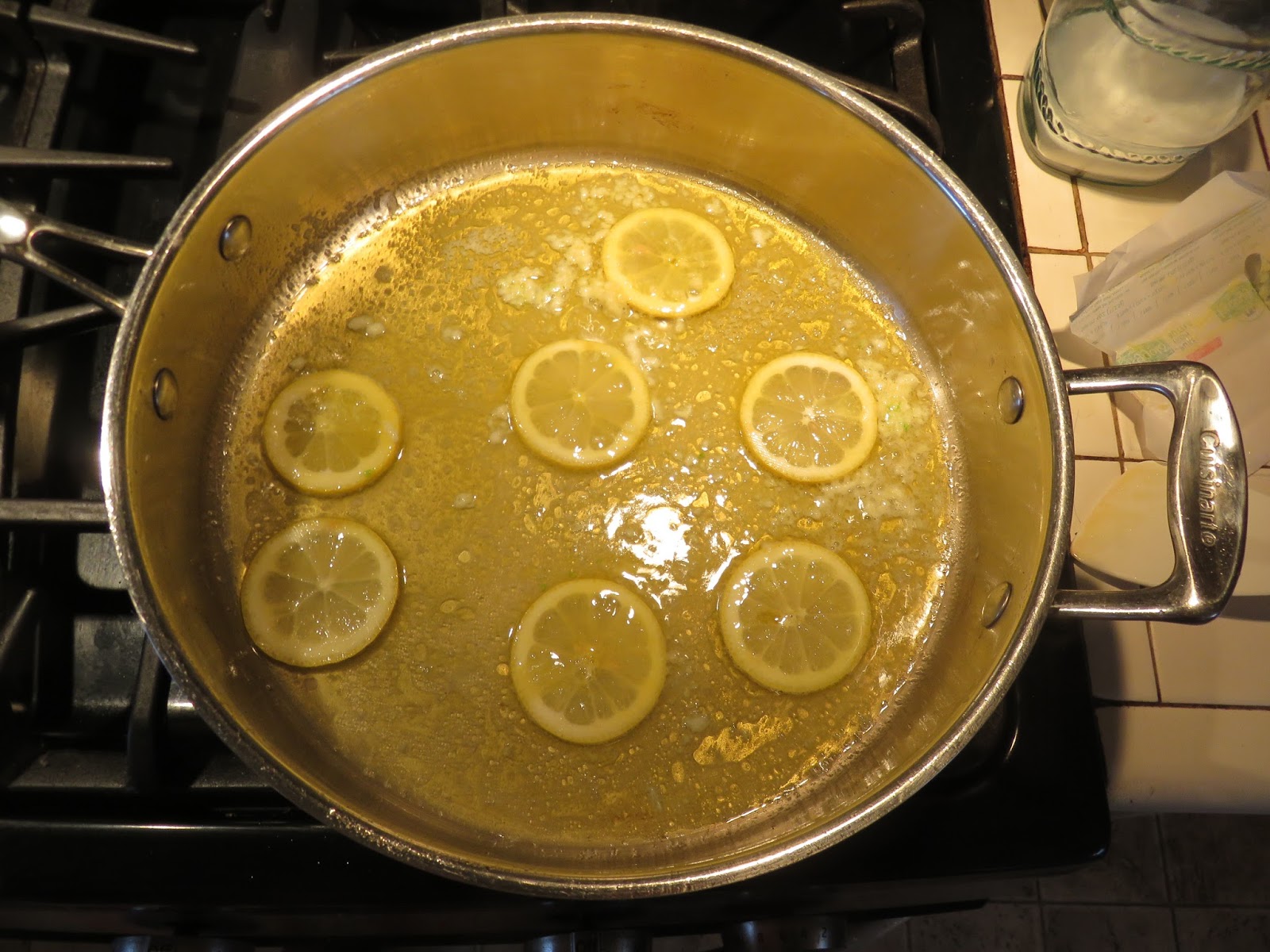
Add the remaining 3 tablespoons of olive oil, butter, garlic, lemon juice and lemon slices to the skillet. Cook, scraping the bottom until garlic is golden brown, about 3 minutes. 

Scoop out the lemon slices and set aside. 


Add the capers and cook, stirring gently, for about 4 minutes. 

Pour in the wine and bring to a boil. Cook until the wine is reduced by half. 

Add the chicken stock and boil until the liquid is slightly syrupy.


Return the chicken pieces to the skillet and coat each piece in the sauce. Add the parsley and swirl into the sauce. Serve with rice or fine noodles.


What makes this recipe a bit out of date? For one thing, the amount of butter used. For another, the length of cooking times (if you used the chicken breasts originally called for, they’d be like leather when you were ready to serve). But the dish did taste good!

When you read this, I will be at the annual Malice Domestic conference with a few hundred or more of my cozy writing buddies and readers, celebrating books. I'll respond to your comments whenever I get a free minute or two!


Friday, April 28, 2017

Ginger Lemonade

Recently I was at a bookstore with a nice café for a signing. Since I was supposed to read something and I was thirsty, I ordered a cold drink. I was in a daring mood and asked for a ginger lemonade, which I’d never tried. And I really liked it!


I’m trying to find alternatives to caffeinated drinks—I confess that I love coffee and tea and various forms of iced tea, but that can add up to a lot of caffeine. But I haven’t been impressed by the non-caffeine commercial varieties of drinks. This, however, fit the bill nicely.

So I went looking for recipes for ginger lemonade. (I admit that you can always go the easy route: buy a gallon plastic jug of supermarket lemonade and a bottle of ginger syrup (if you can find or order one), mix and pour over ice. Done.) But where’s the fun of that? And how many preservatives come along for the ride? Ginger lemonade is pretty simple to make.

I was surprised to find a range of possible recipes online, and no two were the same. although they all boil down (a pun!) to making some sort of ginger/lemon syrup.

Variations include: how to deal with the ginger (slice or grate), what ratio of lemon juice to water to use, whether or not to include lemon peel, and what kind of sweetener to use and how much. But no matter how you make it, it makes a great drink for a hot day. Me, I opted for simple (I hate to grate anything—I’m always sure I’ll grate my fingers).


Ginger Lemonade

Ingredients:

That thing in the middle is my lemon squeezer
6 cups water
1-1/4 cup sugar
2 ounces of fresh ginger, peeled and thinly sliced 
     (you should have about 1/3 cup of slices)
1/2 cup fresh lemon juice (three large lemons)

Sliced ginger


Instructions:

Steeped ginger and sugar
Combine one cup of water, the sugar and the sliced ginger in a small saucepan. Bring to a boil and cook, stirring until the sugar dissolves. Remove from the heat and let cool (the longer it sits, the more intense the ginger flavor).

Juice from three lemons
Strain the mixture through a sieve into a pitcher. Add the remaining 5 cups of water and the lemon juice and stir. Serve over ice.


I was happy with the results. It might taste a bit sweet to some people at first, but if you add ice it will get diluted. I thought the juice:water ratio was just right. Feel free to experiment, especially on hot summer days!


One interesting point: I have a lot of vintage cookbooks, so I went looking in them to see if there was a ginger lemonade recipe from the past. I couldn’t find one. There are plenty of gingerbread or ginger cookie recipes, going back centuries, but nothing using fresh ginger. And then it hit me: it probably wasn’t available. Powdered ginger is easy to make and ship, but most ginger grows in exotic and distance places, and the fresh kind wouldn’t last over a long ocean voyage. So oddly enough, ginger lemonade seems to be a relatively modern recipe.

A note to my readers: I will be attending the Malice Domestic mystery conference in Maryland for a few days, along with many of my writer friends. If I don't respond to your comments immediately, that's my excuse! But I will read them when I return, I promise!

And if you're looking for summer reading and it's hot, try my County Cork series--the weather is pleasantly cool there all summer. The most recent book, Cruel Winter, takes place during a snowstorm!


www.sheilaconnolly.com

Friday, July 22, 2016

Citrus-Poached Fish

It has been hot here in Massachusetts lately. I do not have air-conditioning (I have lots of fans and windows that open on both sides of the house, but it’s not the same, believe me). And there’s a heat wave scheduled for today, and tomorrow, and . . .  So lately my thoughts have run to recipes that involve a minimum of heat to prepare.

Oh, all right, it's not Massachusetts. But this
is how it feels!

Sure, I could grill food outside, but for a few weeks it’s been only me at home (spouse has been gallivanting around the world to exotic places where other people prepare his food for him), and it seems a waste to stoke up the Weber to grill one pathetic piece of chicken.

So, I looked to fish. Cooks quickly. Adapts to just about any flavor. Healthy. Over the years I’ve provided MLK readers with a lot of fish recipes, from creamy to spicy. Well, here’s yet another one!


Citrus-Poached Fish

(This recipe serves four; I made a half recipe)


Ingredients:

3 lemons
1-1/2 cups chicken broth
2 Tblsp dry white wine
1/2 cup chopped shallots
2 Tblsp fresh dill
2 Tblsp drained capers (note: the capers were in short supply in my pantry, so I added a few green peppercorns to spice things ups)
4 fish fillets (a generous pound total)—you can use any firm-fleshed white fish, such as cod. I chose pollock, because at our market this week it was wild-caught and never frozen.
4 tsp olive oil
Salt to taste

Slice one of the lemons in half and squeeze to make 2 Tblsp juice. Slice the remaining lemons thinly.


In a large skillet, combine the broth, wine, lemon juice and shallots. Bring the mixture to a boil over medium-high heat. Boil for 2 minutes, then reduce the heat and simmer for another ten minutes. Stir in the dill and capers.

Dill

Place the fillets in the liquid. Drizzle with the olive oil and lay the lemon slices on top. Simmer, loosely covered, until the fish flakes easily (this should take about 5 minutes, depending on the thickness of your fillets).

Ready to cook
Taste the broth and add salt if needed. Serve with rice or couscous, and spoon some of the cooking liquid over the fish.


This is the next book, Seeds of Deception, coming from Berkley Prime Crime in October. As you can guess from the cover, it takes place in winter.

In this I've managed to combine Monticello and the Mafia, and the town where I went to high school. It was a lot of fun to write.

You can pre-order it at Amazon and Barnes & Noble.


As it happens, I'm working on two other books at the moment: the next County Cork mystery, Winters Past, also set in winter (with a blizzard!); and the next Relatively Dead mystery (still nameless), which takes place in October. Good planning, right? At least I can think cool thoughts while I swelter at my keyboard.

Tuesday, July 5, 2011

How Snakebites and Bleach Can Quench Your Thirst


Have you ever quenched your thirst with a Snakebite? No? How about Chlorine Bleach? I know what you're thinking: Are you crazy? They're poison. They'll kill you. Not if you drink them my way....

"Snakebites" and "Chlorine Bleach"
are types of shandies...


Cleo Coyle, who sips Blue
Moons by moonlight, is
author of The Coffeehouse
Mysteries
I never heard of a shandy until I traveled to the UK, where pub life introduced me to the delights of this drink, along with a "ploughman’s lunch," but that's another post.

The shandy I drank, which was a mix of Harp beer and carbonated lemonade, was love at first sip. Bright, refreshing, a delightful summer cooler! Unfortunately, after I returned to America, bartenders shook their heads when I ordered one.

Mixing beer with lemonade? Please. In my hometown, bartenders poured you an Iron City or Rolling Rock off the tap—and that was it. Mixing it with lemonade made as much sense as mixing it with chlorine bleach, which is (ironically) exactly what certain regions of Spain call their version of a shandy. :)

Well, it's over 20 years later and American bars regularly serve Mexican beers (e.g., Corona) with a wedge of lime or lemon.

BTW – I always wondered why this was done. One source claims adding lime and lemon to these beers hides a type of spoilage known as skunking, which comes from exposure to light or heat during shipping—an especially common problem with beer shipped in clear bottles.

A squeeze of citrus was supposed to mask this defect, and according to at least one Texan I know, the citrus also "keeps the flies out of your beer." :)

These days, even standard American brands like Bud and Miller are marketing a variety of bottled beer already mixed with lime. My favorite of this new trend comes from the Coors brewery in Colorado, which introduced a very nice line of bottled beers with citrus notes, under the Blue Moon label. (I could drink these babies all day...)


Like many lagers, Brooklyn is
a bit bitter. For me, it didn't
work in a shandy. I also
found the Sprite too sweet
and cloying.

SO HOW DO YOU
MIX A SHANDY?

Generally speaking, a shandy is a lager beer mixed with a citrus-beverage like lemonade, or a citrus-flavored soda (such as Sprite or 7-Up). The proportions are generally half-and-half, but almost everyone (including me) adjusts to taste.

NOTE #1: I've tasted many versions and concluded that lagers (like the Brooklyn Lager in my photo at the right) are too bitter to use for a shandy. I strongly recommend using a pale lager like Heineken, Corona, Amstel Light, Rolling Rock, Michelob, Coors Light, or the Japanese Sapporo.

For more on pale lagers, click here.

NOTE #2: Frankly, I find Sprite and 7-UP to be too sweet and cloying for the drink. For my taste, the very best shandy will always be made with lemonade...

As for the Snakebite and Chlorine Bleach, you'll find them listed below, along with some other names for this drink...

SHANDYGRAFF, as it's known in the UK, is a mixture of beer and ginger beer or ginger ale.

LAGER TOPS is also served in the UK; it's made by pouring a layer of non-carbonated lemonade or freshly-squeezed lime juice over the top of a beer before serving.

BLACK SHANDY is enjoyed in Canada; it uses stout (instead of lager) with a carbonated citrus soda.

OLD GROUCH ("Brummbär") is Germany's mixture of stout and cola.

SNAKEBITE is an American version that uses beer and hard (alcoholic) cider. (Note: See the comments section of this post for a note from Riley/Elizabeth on this drink.)

DEVIL is Belgium’s version of a Snakebite. 

PANCAHE, served in Italy and French-speaking Switzerland, is a shandy made with lemon-lime soda (e.g. 7-UP or Sprite).

STING ("pika") is the name for this same drink in Basque, Spain.

CHLORINE BLEACH ("leija") is apparently what they call this drink in Spain’s Guipuscoa region!


To read more about the differences among lager, ale, stout, and porter, click here.

The link will take you to Riley Adams' (Elizabeth Spann Craig's) informative post for this blog: A Side Order of Beer.


Finally, here's how I make
a shandy in Queens, New York...


CLEO COYLE’S
SUMMER SHANDY

Per serving...

1 glass or mug (frosted is suggested)

1 bottle of pale lager beer (trust me, use a pale lager*, other lagers are too bitter)

Lemonade (carbonated is traditional, but I use non-carbonated and enjoy it. You can also make your own carbonated lemonade by mixing fresh lemonade with club soda.)

Method: First pour the beer into your glass. Add the lemonade. To what ratio? I recommend 3-parts beer to 1-part lemonade. You’ll enjoy a refreshing citrus note without flattening or overwhelming the beer.

*As mentiond in my post above, examples of pale lagers include (but are not limited to) the brands: Heineken, Corona, Amstel Light, Rolling Rock, Michelob, Coors Light, or the Japanese Sapporo.


Drink with joy!


~ Cleo Coyle, author of 
The Coffeehouse Mysteries


To get more of my recipes,
sign up to win free coffee,
or learn about my books,
drop by my *virtual*
coffeehouse at...


CoffeehouseMystery.com


Murder by Mocha

Releasing August 2nd

Includes chocolate recipes!

"...a tasty espresso-dark tale of
multigenerational crime and
punishment lightened by the Blend's
frothy cast of lovable eccentrics."
~ Publishers Weekly


To pre-order from Amazon, click here 

To pre-order from Barnes and Noble click here for the book; for the Nook click here.


Roast Mortem

Includes firehouse recipes!
A Reviewer’s Pick 
Favorite Book of the Year ~ 2010
Bookreporter.com
 
Coming to paperback
August 2nd

 
To pre-order
from Amazon click here.

To pre-order
from Barnes and Noble,
click here.