


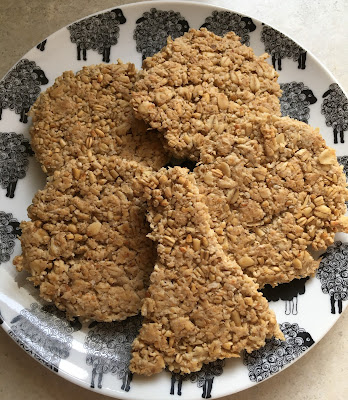
Oatcakes and a piece of good cheese – Mm-mm! I’m looking forward to March 1st, when Argyles and Arsenic hits bookstores and libraries, so my next several contributions to the MLK kitchen will be Scottish recipes.
Oatcakes
are a traditional Scottish cracker. They’re great on their own or served with
salted butter, cheese, pate, smoked salmon, etc. They’re quite easy to make,
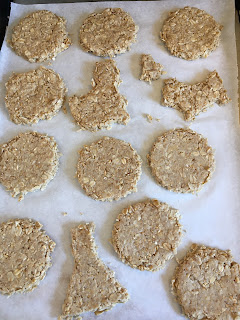
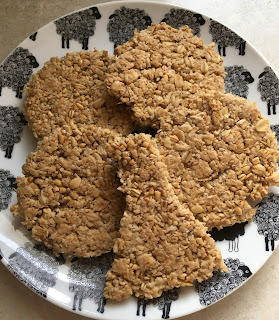
too, although I attempted to get fancy and make some in the shapes of characters in the book - including Ranger the
cairn terrier, Smirr the big gray tomcat, and Butter the yellow kitten. Oh, I
had plans! I thought of making one each in the shape of the women who run the
bookshop and tearoom, one for the constable, and one for the Mr. Potato Chef
food truck that appears in the book.
Sadness.
The little dog lost a leg. The cats are hideous. And I gave up trying to
freehand anything else. But not entirely. I did do one freehand shape. You can see
it on the plate along with the traditional round oatcakes. Do you know what it is?
Yes! It’s a vial of arsenic (although it looks more like a rocket ship's re-entry capsule).
The
recipe is written with metric amounts. I’ve added the cup and ounce equivalents
in parentheses.
If
you’re looking for more Scottish recipes, here are three from the MLK
archives.
Orange
Almond Scones with Cardamom
Oat
Shortbread with Dark Chocolate and Crystalized Ginger
Mary
Jane Maffini’s Great-Great-Grandmother’s Scottish Shortbread
Scottish
Oatcakes
(adapted
from The Hebridean Baker: Recipes and Wee Stories from the Scottish Islands)
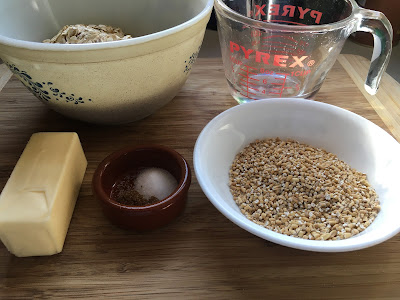
Ingredients
200g
(2 cups) rolled oats
50g
(⅓ cup) pinhead or steel-cut oats, plus extra for dusting
½
teaspoon salt
¼
teaspoon brown sugar
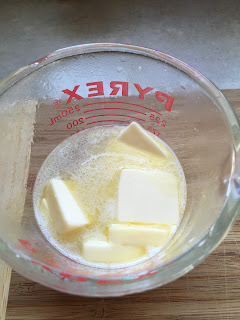
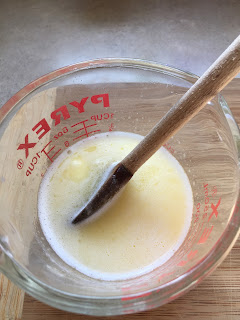
75g
(⅓ cup) butter
75ml
(¼ cup 2 tablespoons) boiling water
Directions
Preheat
oven to 360 degrees F (the recipe
calls for 180 degrees C which is 360 degrees F). Line a cookie sheet with
parchment paper.
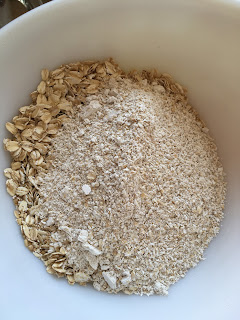
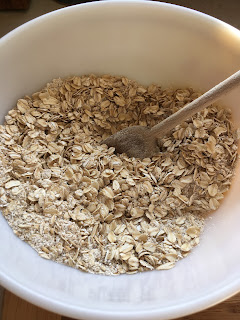
Stir
rolled and pinhead (or steel-cut) oats together. Whir 100g (1 cup) of that mixture in a blender to
make oat flour. Return the flour to the bowl. Add salt and sugar.

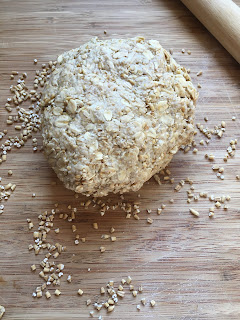
Dust
your work surface with pinhead oats (Note: I had steel-cut oats which just
plain do not dust a work surface. Next time I might dust with whole wheat
flour, or I might whir the extra steel-cut oats to make more oat flour and use
that.) Roll dough to a thickness of about ¼ inch.
Use
a biscuit cutter, or other shape of your choice to cut the dough. (Note: after
I gave up being fancy, I used one of the round biscuit cutters I bought when I
was a student at Edinburgh University in 1974. Worked like a charm.) Lift the
oatcakes with a palette knife or metal spatula and arrange on parchment-lined
sheet. Re-roll scraps until dough is used up. (Note: this wouldn’t be
traditional, but it would be quick – cut the dough into rectangles or triangles
with a chef knife or pizza cutter.)
Bake
20 minutes. Turn oven off. Carefully turn the oatcakes over and return to oven
for 5 minutes. (Note: I forgot to turn the oven off before I returned the
oatcakes for the last 5 minutes. It didn’t hurt them.)
Remove
from oven. Transfer oatcakes to cooling rack.
Serve
with salted butter and cheese (or anything else that sounds good!).
Something
poisonous is coming March 1, 2022!
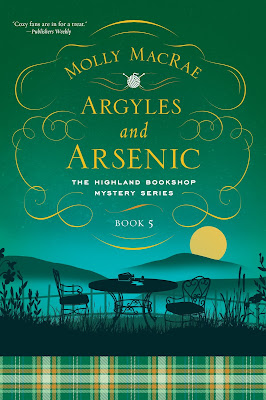
About Argyles and Arsenic – book 5 in the Highland Bookshop Mysteries:
After
93 well-lived years, Violet MacAskill is ready to simplify her life. Her
eccentric solution? She’ll throw a decanting and decluttering party at her
family home—a Scottish Baronial manor near the seaside town of Inversgail,
Scotland. Violet sets aside everything she wants or needs, then she invites her
many friends in to sip sherry and help themselves to whatever they want from
all that’s left.
But
a murder during Violet’s party leads to a poisonous game of cat and mouse –
with the women of Yon Bonnie Books playing to win.
Available for pre-order in hardback and e-book from your locally
owned independent
bookstore, Barnes &
Noble, and Amazon.
Or ask your public library to consider ordering it.
The Boston Globe says Molly MacRae writes
“murder with a dose of drollery.” She’s the author of the award-winning,
national bestselling Haunted Yarn Shop Mysteries and the Highland Bookshop
Mysteries. As Margaret Welch, she writes books for Annie’s Fiction. Her short
stories have appeared in Alfred Hitchcock Mystery Magazine since 1990
and she’s a winner of the Sherwood Anderson Award for Short Fiction. Visit
Molly on Facebook and Pinterest and connect with
her on Twitter or Instagram.


